Visit our Re-post guidelines
Given the last half-decade of inappropriate pandemic response measures and fear-based global governance, the public is reasonably concerned whenever a new potential “outbreak” is announced. The global population is now easily manipulated into a state of fear, whether of the alleged pathogen itself or of the strict measures governments might impose in response to the stated threat.
This was true recently with Hantavirus, with Monkeypox, various animal-related influenzas, and, of course, the perpetually stated threat of the looming emergence of new Covid-19 strains. After years of perennial debate about lab leaks vs. natural origins regarding Covid-19, the mind of the average media consumer is primed to receive frightening news out of a foreign country about a dangerous new threat escaping a lab and galloping across the world.
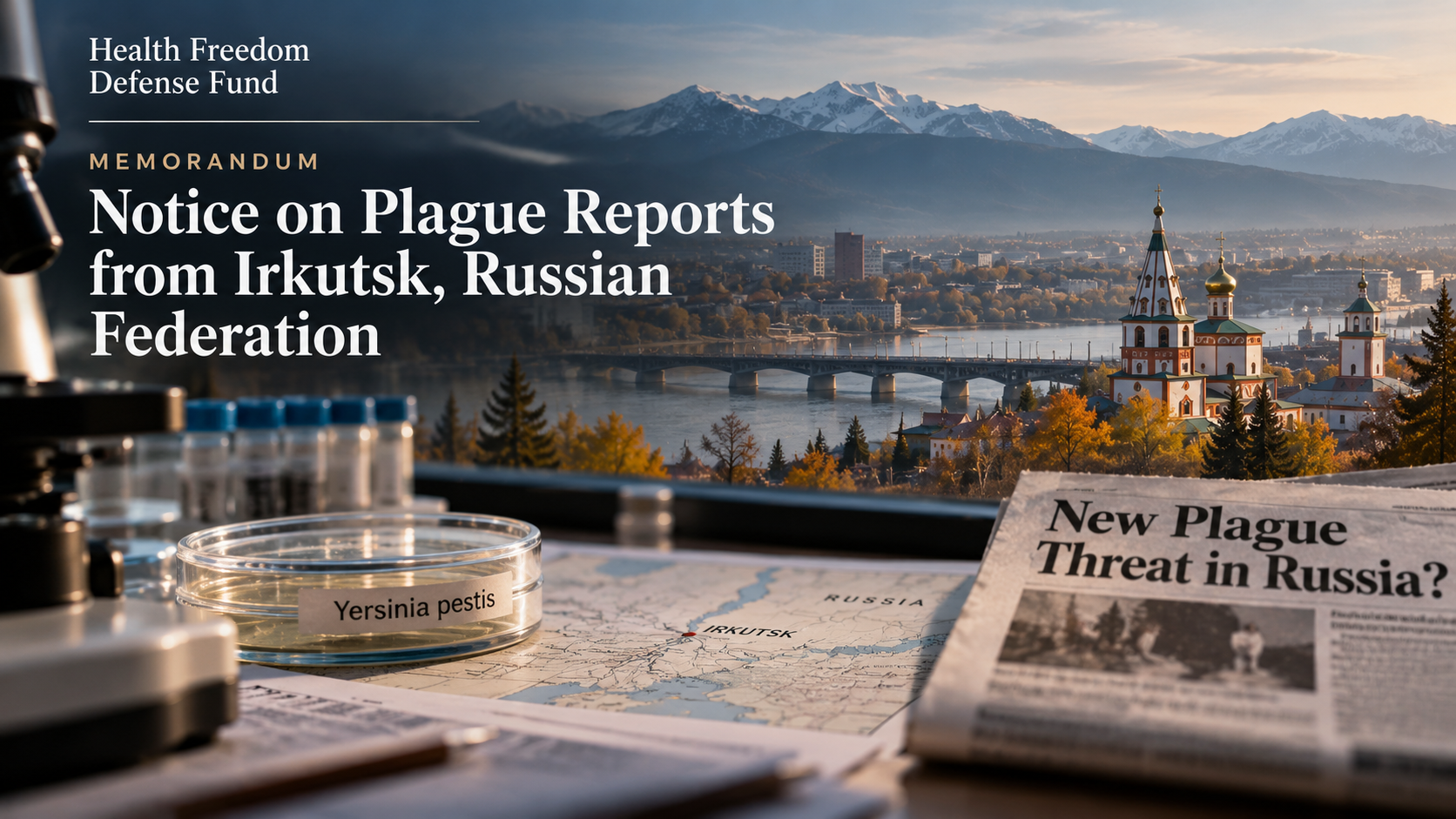
In this case, it has been reported this week that a young Russian researcher died of pneumonia, one of the leading causes of death in the world. Her death was deemed particularly notable in the media due to where she worked as a yersinia pestis (plague) researcher. This was amplified by ambiguous, unsourced, conjectural reporting in local and global media, complete with speculation about broken vials, dangerous weaponized modifications to plague strains, and similar dramatic scenarios. Often, these writers are also selling books on the topic.[1]
However, the Russian equivalent of the CDC (Rospotrebnadzor) has publicly stated that initial testing does not indicate that plague was involved. Their exact language likely means they conducted a bacterial culture (growing a sample to see whether a particular bacterium is present and viable), which takes 2 days to process. This makes sense as the researcher died on October 2nd and this statement was released on October 4th. While a negative culture does not mean she never had active plague bacteria in her system, it is informative. Moreover, Rospotrebnadzor reports a contact-tracing operation that has thus far identified no plague cases or even reported illness. Likely, any contacts are on an intensive preventive course of antibiotics. Given this, it is unsurprising that hospitals in the area are under administrative quarantine, likely because of this antibiotic preventive strategy and because, for statutorily required public-safety purposes, further blood tests, bacterial culture, and other diagnostic work for contacts are underway.
It is critical to state that to date, no widespread illness has been reported, as with most plague cases. With modern sanitation, pest control, and antibiotics, such clusters of diagnoses are locally confined and quickly extinguished as a source of concern. Unless, of course, such concern or panic could benefit powerful interests like the WHO, reeling from defunding and institutional irrelevance; or the CDC, eager to point the hostile news media’s attention overseas. In that case, vigilance of a different kind is warranted. More importantly, at least 21 plague-targeting vaccines (including viral vector, mRNA, live-attenuating, and self-replicating RNA approaches) are in development, and media panic on this issue can help secure financing and even expedite approval for these candidates. Therefore, any undue excitement about this story should be viewed through a skeptical lens.
Simply put, given the currently available information, the situation should not be cause for concern. This is not because we must trust the Russian official reports (although if the premise is that the Russian government controls the media, if they wanted to cover it up, presumably the story would not be discussed in the first place). Rather, concern, let alone panic, is not reasonable because of what we know about the plague bacterium and the lack of danger it poses to the public in the modern age.
The United States’ CDC reports that the US averages seven plague cases a year, mostly in the Southwest where rodents are common, yet the media pays little attention to these cases because they are easily treatable. Despite these rare but occasional human cases, the disease has not spread uncontrollably or caused widespread death. Last year, one person died with plague in their system in Arizona after desert rodents apparently spread the disease to his cats and then to him—an unfortunate but extremely rare occurrence. Overall, 12 people have died with plague in their bodies according to the same report, since 2004 in the US. The case frequency is roughly the same as the hyper-rare but terrifying brain-eating amoebas (Naegleria fowleri), which are not claimed to be contagious human-to-human. So, the risk of meaningful contagion is nearly zero by the official numbers.
Globally, the numbers are similar, as there are roughly 600 cases a year on average, with extremely rare fatal complications, resulting in 584 documented deaths over the entire 10-year period from 2005 to 2015, mostly in very impoverished settings like Madagascar, Congo, and Peru, where antibiotic initiation may be delayed. Even there, the outbreaks are limited.
For the foreseeable future, plague bacteria will occasionally be present in remote, mountainous regions and some desert settings where rodents are numerous due to sparse human presence. In the Russian region of Buryatia, where the Russian researcher likely collected her samples, it is quite common to find it in local animals and occasionally in people. The research focused on which strains of plague respond best to which types of antibiotics—there is no indication this work involved “gain of function” modifications or weaponization of bacteria, as some breathless reporting insinuates.
So far, there are no dubious internet videos of Irkutsk residents collapsing like mannequins in the street, as China publicized in 2020. We are not being subjected to, as of yet, absurd animated videos of the danger we are all in just by virtue of being in proximity to other humans. So far, the media are not asking ridiculous questions like, “How safe is fresh air?” for people jogging outside.
Despite this, HFDF does not doubt that some state or private actors may wish to manipulate this situation for geopolitical or domestic political gain. If the situation is indeed overblown, the best defense against being manipulated again is to be skeptical of bombastic claims in any direction, and to avoid making decisions based on fear of pathogens, or fear of state-sanctioned adversaries. For example, subsequent and inevitable pneumonia deaths, which occur regularly in the harsh climate of Siberian fall and winter, should not be credulously attributed to plague merely because “the Russians” deny that this is the case. We will continue to monitor the situation—the HFDF team includes former infectious disease program specialists who have worked in the Siberian health system and are well-situated to monitor both press and official reports.
[1] Annie Jacobson, for example, advertises her current book as “nightmare fuel” and touts the claims of Ken Alibek, a former Soviet scientist during the 20th century, who also played a role in convincing the US to invade Iraq, based on his alleged expertise in weapons of mass destruction. His claims of “Ebola-pox” and super-plagues were well understood as more fanciful than technically viable.