Visit our Re-post guidelines
“In the Middle Ages, medicine was still in its infancy. The art of healing was conducted not by physicians but by barbers. The medieval barbers were the forerunners of today’s men of medicine, and many of the techniques they developed are still practiced today. This is the story of one such barber.”
Opening scroll to Saturday Night Live’s 1978 comedy sketch, “Theodoric of York, Medieval Barber”
In one of the most brilliant skits in Saturday Night Live (SNL) history, guest host Steve Martin plays Theodoric of York, a 14th-century barber-surgeon who confidently attributes his patients’ ailments to bizarre causes, like “toads or a small dwarf living in her stomach.” Guided by supreme overconfidence, he treats every malady with bloodletting, leeches, and stomach-churning poultices made of boar’s vomit or boiled sheep’s urine. As he inflicts these painful treatments, he dismisses his patients’ suffering, entirely unbothered by their predictably bad outcomes.
While this classic sketch is set in the Middle Ages, it perfectly encapsulates the foundations of “heroic medicine”—the dominant allopathic model of the late 18th and 19th centuries. The parallels are striking. When Theodoric’s assistant asks if they should perform the “usual bloodletting,” he confidently applies agonizing treatments to “draw out” illnesses, flawlessly mirroring the brutal logic of early American healthcare.
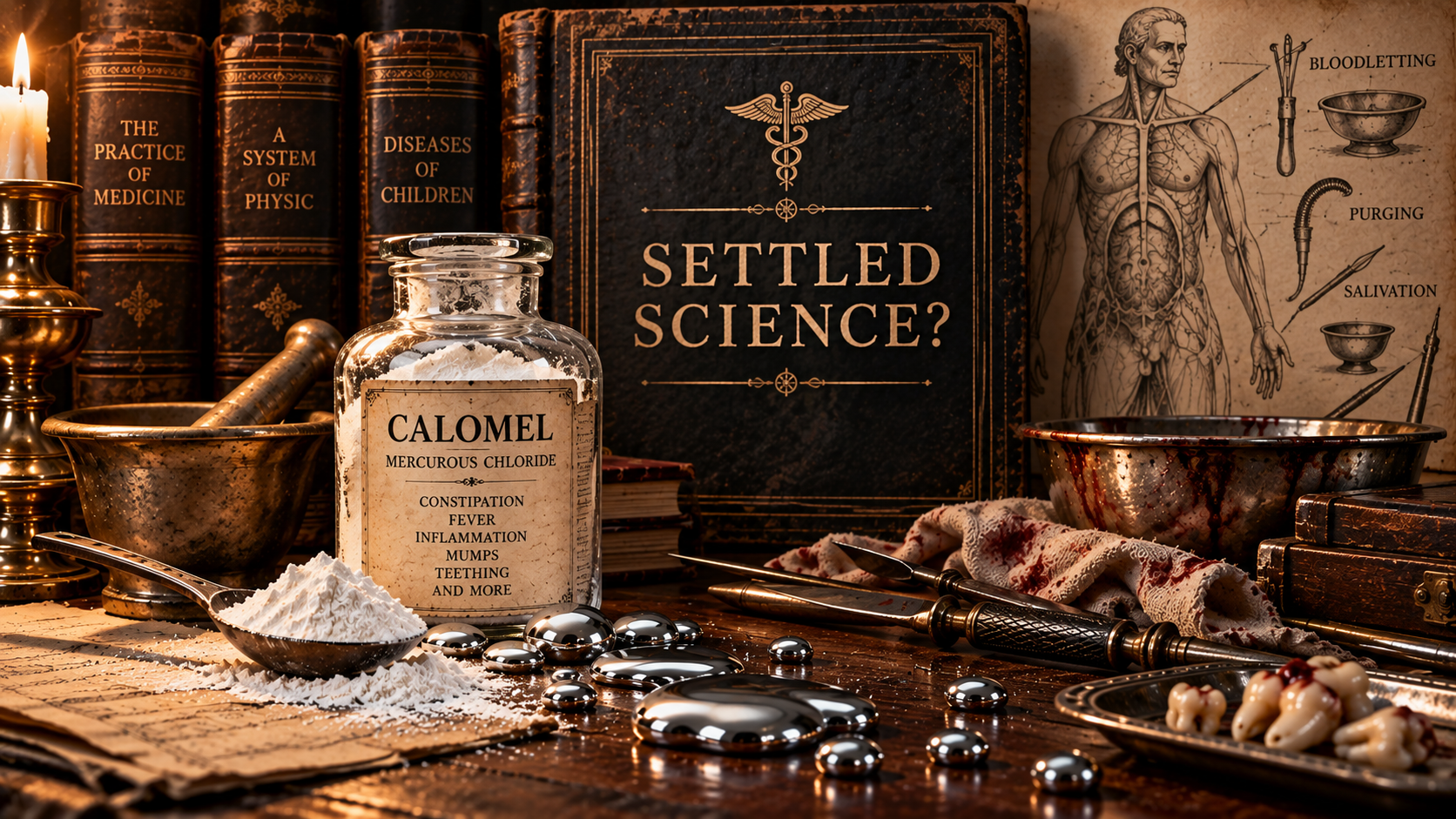
During this formative period, the medical establishment operated under humoral theory, which viewed the human body as a system of fluid balances. Under this “settled science,” an “over-stimulated” or “congested” system required aggressively forcing toxins out. Early physicians believed that curing an illness required producing a physical effect directly opposite to the symptom—essentially bludgeoning the disease out of the patient.
Samuel Hahnemann, the founder of homeopathy, coined the term “allopathy” (from the Greek allos, meaning “other,” and pathos, meaning “suffering”) to describe this method. Hahnemann argued that attacking symptoms with violent opposites was fundamentally irrational and barbaric, maintaining that these harsh treatments merely weakened the body, inflicted unnecessary suffering, and routinely killed the patient. Yet, top medical schools explicitly taught that these depletion therapies were the most advanced way to save a life; any doctor who refused to bleed a patient or purge their bowels was deemed negligent by his peers.
This philosophy fueled the widespread use of calomel (mercurous chloride), a dangerous mercury compound regularly prescribed as a cure-all from the 16th century until the mid-20th century. Administered as a white powder, this heavy laxative and disinfectant was used to treat everything from constipation and mumps to yellow fever and infant teething. It was often paired with “Blue Mass”—pills crafted by mixing elemental liquid mercury with chalk, licorice, and honey. Calomel wasn’t just some experimental elixir peddled by back-alley hucksters; it was the definitive “go-to” drug for orthodox physicians, heralded as a panacea by the self-proclaimed “ministers of modern medicine.”
Because calomel triggered immediate and violent evacuations—including profuse salivation, severe vomiting, and extreme purging—allopaths hailed it as a miracle drug. To these medical authorities, the proof that calomel “worked” was simply that they could visually witness it doing something. This preposterous logic equated physical trauma with therapeutic efficacy. If a patient’s gums began to swell, bleed, and ulcerate, physicians celebrated it as successful “salivation”—grotesque “proof” that the mercury was drawing the disease out of the internal organs and dragging it into the mouth to be expelled. When patients grew sicker from heavy metal poisoning, physicians simply assumed the underlying disease was exceptionally stubborn and doubled the dose.
A prime example was Benjamin Rush, the “father of American medicine,” who zealously championed “heroic doses” of calomel, while proudly dubbing the toxic compound the “Samson of medicine.” This approach frequently proved fatal to the very people it was meant to cure. Most famously, while on his deathbed in December 1799, George Washington was subjected to these exact remedies. To treat what is now believed to have been a severe throat infection, his physicians subjected him to massive bloodletting, painful blistering, and heavy doses of calomel. Over a span of just twelve hours, they drained nearly 40% of his total blood volume, directly hastening his death.
Because this methodology was central to their professional identity and emerging business model, allopaths fought viciously against contradicting evidence. Licensed physicians formed exclusive societies to protect their consensus, weaponizing institutional power to enforce monopolies. Anyone questioning their authority—whether homeopaths, herbalists, or midwives—was legally and socially branded a “quack.” By consolidating control over hospitals, military supply lines, and government health boards, mainstream doctors successfully used state machinery to mandate treatment standards and crush competing philosophies.
This dynamic reached a fever pitch during the American Civil War when Union Surgeon General William A. Hammond banned calomel from military supply tables. Horrified by how the toxic compound disfigured soldiers, Hammond sought to protect them from mercury poisoning. Far from thanking him, conventional physicians were outraged, lambasting his directive as unscientific and launching the “Calomel Rebellion.” Weaponizing their influence, medical societies withdrew political backing, aligned with Hammond’s enemies, and pressured the government to remove him via a court-martial on trumped-up charges.
This rigid dogmatism, promoted as “the settled science”, triggered a fierce medical schism in America. As conventional treatments routinely rotted jaws and dislodged teeth, patients grew terrified of mercury therapies. This widespread public panic fueled the rise of eclectic practitioners, naturopaths, and homeopaths. Rallying under the slogan “No mercury!“, these competing schools captured the market with gentler alternative remedies. Horrified by conventional physicians prescribing calomel to infants, wealthy mothers became fierce champions of homeopathy. This upper-class backing infused the alternative movement with social prestige, hospital funding, and political insulation just as mainstream boards tried to outlaw them.
As the 20th century approached even some mainstream doctors were coming to the realization that humoral theory and calomel were becoming scientifically indefensible leading to restrictions by some hospital physicians. However, rather than letting this toxic legacy destroy their credibility, they pivoted by changing the rules of the game. Instead of admitting fault, the medical “experts” consolidated power, outflanked competitors, and codified their practices into a strict legal monopoly. By dominating state licensing boards and rewriting educational standards, they ensured they remained the sole arbiters of “legitimate” science—burying a history of bloodletting and mercury poisoning beneath a new veneer of exclusive authority. This institutional capture allowed mercury-based drugs to survive into the mid-1900s, driven by a shift in how the drug’s violent physical effects were rationalized.
Though its use shifted, calomel survived well into the 20th century as the primary ingredient in infant teething powders; it was only after researchers in the late 1940s and 1950s definitively linked the product to acrodynia—a severe, frequently fatal form of childhood mercury poisoning known as “pink disease“—that public health interventions finally halted production.
The supreme irony is that conventional physicians branded their rivals as “quacks” while they themselves were draining pints of blood and feeding patients spoonfuls of mercury—systematically destroying the public’s health under the banner of science.
This dogmatic lunacy bears an eerie resemblance to modern pediatric visits, where parents watch a healthy child become feverish and miserable hours after vaccination, only for the pediatrician to assure them that the distress is simply a sign that the body’s defenses are successfully “working.”
The “heroic medicine” mindset—characterized by supreme confidence in aggressive, invasive interventions that later prove harmful—is not a relic of the past. As our series will illustrate, the history of conventional medicine is rife with examples of dangerous, unscientific quackery masquerading as legitimate science. Lest we forget, mercury elixirs and mummy powder were not so long ago celebrated as the cutting edge of human knowledge.
Ultimately, the story of calomel serves as a stark reminder that institutional authority, elite consensus, and “settled science” are never synonymous with truth. Theodoric of York’s legendary line—“You know, medicine is not an exact science”—was the very shield 19th-century allopaths hid behind while dispensing literal poison. It remains as chillingly relevant today as it was centuries ago.