Visit our Re-post guidelines
Here we go again with another story about an alleged deadly pathogen that “could” or “might” or . . . well, you get the drift . . . wipe out the entirety of the human race . . . or at least make some pharma stocks rise in the short-term while priming the pump for even greater gains in the long-term.
This time it’s the deadlier-than-ever hantavirus that’s the culprit. But not just any version of hantavirus, mind you. We’re talking the Andes strain, which supposedly has the uncanny ability to leap from human to human and cause all sorts of nasty problems if left unchecked—or so we’re told.
Dutifully serving their masters, the maniacal mainstream presstitutes have opened the spigot of fear full blast to make sure every person on the planet gets fully saturated with their daily dose.
As expected—you might even say “as required”—most pertinent details have been purposely omitted by the corporate media. In fact, it appears that they—and most of the “alternative” media—are completely forbidden from doing a proper forensic analysis. Pity that, considering this tale has enough plot twists and intrigue to launch another contagion-themed Netflix series.
The short version of the narrative goes like this:
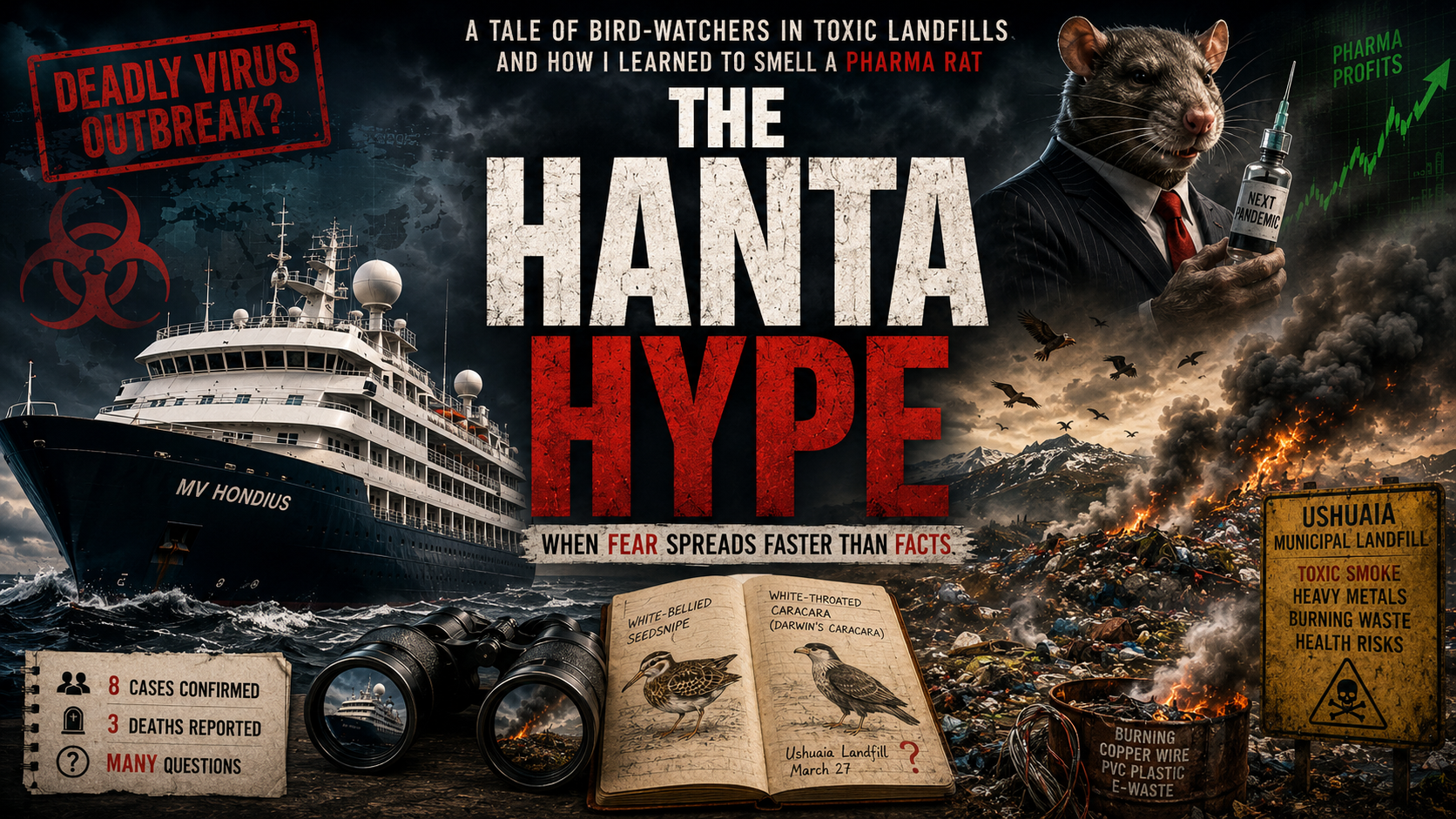
In April, an outbreak of a rare and deadly hantavirus is linked to the cruise ship MV Hondius in the Atlantic Ocean. At least eight cases and three deaths are confirmed. The main characters in the story are a Dutch husband and wife who were on a birdwatching expedition in South America, where they apparently caught the Andes strain of the hantavirus and subsequently died from the infection.
The longer version goes like this:
Leo Schilperoord, a 70-year-old Dutch ornithologist from Haulerwijk, and his 69-year-old wife, Mirjam Schilperoord, arrived in Argentina on November 27, 2025. The couple traveled by van for several months before eventually parking the vehicle in Montevideo and flying to Ushuaia, Argentina, to join the cruise. On March 27—just days before boarding the MV Hondius—they went on a birdwatching excursion to a landfill about four miles outside of Ushuaia.
On April 1, they boarded the ship. On April 6, Leo is said to have developed viral symptoms, and on April 11 he died while still on board the ship in the South Atlantic. Mirjam accompanied his body for repatriation but then fell ill herself and died in a hospital in Johannesburg, South Africa, on April 26.
Of significant import is the Ushuaia municipal landfill that Leo and Mirjam visited on March 27, 2026. It’s a heavily contaminated site that happens to be a popular destination for birdwatchers who hope to spot the elusive White-bellied Seedsnipe and the rare White-Throated Caracara (also called Darwin’s Caracara).
Indeed, toxic exposures from the Ushuaia landfill are so well-known among residents that they avoid the landfill like the plague despite it being a pilgrimage point for birdwatchers from all over the world. The smoke from the burning rubbish is reportedly so intense that it “burns the throat.”
When the dump is sweltering under an especially hot sun and being whipped by especially strong Patagonian winds, the environmental hazards are amplified. On those days, a yellow weather alert warns the locals to stay inside their homes. The deserted streets are proof that they’re heeding the message. They know, from experience, that the high-knot winds will leave in their wake a greater risk of illnesses, including respiratory and skin issues, gastrointestinal infections, congenital disabilities, and cancer risks.
Historically, winds in Ushuaia during the month of March average 14 to 20 miles per hour. On the afternoon of March 27, the breeze was within that normal range. The presence of wind at the municipal landfill is a critical detail because, at 14–20 mph, the wind would have kicked up contaminated dust and toxic smoke as the couple moved around the site to photograph birds.
Burning copper cables to extract the valuable copper wire is particularly dangerous to human health, especially when the cables have PVC (polyvinyl chloride) insulation. The primary toxic chemicals in PVC include:
- dioxins and furans (byproducts that can contaminate soil, water, the food chain, and the human body);
- heavy metals (lead, mercury, cadmium, chromium VI, which leach into the environment and pose risks to human health). The lead from burned copper wire ash, for example, can cause neurological damage, organ damage, headaches, and high blood pressure;
- brominated flame retardants (BFRs), which include chemicals like PBDE and PBB (used in cable insulation) and which release additional toxic compounds when burned;
- hydrogen chloride gas, which transforms into hydrochloric acid (HCl) upon contact with moisture and can cause severe respiratory irritation.
Hydrochloric acid, when inhaled, causes severe burns to the respiratory tract and can lead to pulmonary edema (fluid in the lungs). Delayed pulmonary edema can “drown” someone several hours—or even several days—after they leave the area where they have inhaled the toxic smoke.
In addition, the burning of electronic waste at this barely regulated Ushuaia municipal landfill is an informal but persistent practice. Burning e-waste releases dangerous toxins, including mercury vapor, lead, and cadmium. Inhaling these vapors can cause “metal-fume fever,” which has symptoms similar to what is being called “hantavirus.” Scavengers and “urban miners” frequently use open-air burning to strip insulation from wiring and extract valuable metals like copper and gold.
Other scavenging activities at the Ushuaia landfill stir up dust and smoke that aerosolizes all manner of additional toxins. Local community groups, like “Let’s Clean Ushuaia,” have highlighted hazardous waste disposal and environmental neglect in the region.
As for “patient zero” Leo Schilperoord, symptoms reportedly appeared on April 6, just five days after he boarded the MV Hondius. Those symptoms included fever and chills; gastrointestinal distress (specifically, diarrhea); stomach pain and nausea; intense headaches and muscle aches, particularly in large muscle groups like the thighs, hips, and back; and severe respiratory distress, in which the lungs fill with fluid (earlier referred to as pulmonary edema).
All of these conditions match the symptoms one would experience if poisoned by furans, by dioxin exposures, and by copper fumes (black particulate created when copper is heated to high temperatures and dispersed into the air, causing it to vaporize and then condense into microscopic solid particles).
Leo Schilperoord’s condition deteriorated rapidly after April 6. He developed acute respiratory distress, which led to his death on April 11.
The third confirmed death on the MV Hondius was of an 80-year-old German woman on May 2, 2026. Her full name and further details have not been released as of this writing.
The likelihood that the Dutch couple was exposed to highly toxic fumes from the landfill in Ushuaia is a huge point of interest that is completely omitted from the mainstream narrative.
But it’s not the only strange element of intrigue coming from the corporate-controlled media.
Another oddity pounced upon by lapdog journalists is the re-emergence of social media travel influencer Jake Rosmarin. He produced an emotional social media update in which he claimed to be trapped on board the MV Hondius during the reported hantavirus outbreak.
You may remember that Jake was last seen back in 2020, when he put out an impassioned appeal for “gorgeous, gorgeous girls” to get their covid vaccines and boosters. And now we’re supposed to believe that he serendipitously showed up on this cruise ship in a remote location as part of an international story? Really?
Of note, Jake’s sister, Rachel Rosmarin, holds a Master of Public Health (MPH) in Global Health and specializes in disaster recovery and global health crises at Hagerty Consulting. Curiously, she joined Hagerty in August 2020, just as the alleged SARS-Cov-2 roared onto the global scene. Rachel currently serves as a managing associate in the firm’s Recovery Division.
Also of note is that Jake’s husband, Alex Cestari, specializes in science and technology law at Ropes & Gray LLP, a Boston-based multinational law firm. Alex represented Xenon Pharmaceuticals Inc., a neuroscience-focused biopharmaceutical company, and numerous underwriters in bond offerings for Blackstone Private Credit Fund (BCRED). BCRED and its parent, Blackstone, have deep strategic ties to Big Pharma through multibillion-dollar R&D financing agreements and large-scale private credit facilities.
Blackstone frequently collaborates with leading pharmaceutical companies to co-fund the development of late-stage drugs in exchange for future royalties. Blackstone Life Sciences provided up to $750 million in March 2024 to fund Moderna’s mRNA influenza vaccine program. While Blackstone does not currently have a publicly announced direct investment specifically in a hantavirus vaccine, it is heavily linked to the primary players in the space.
Another bizarre story line involves the cruise ship itself and its “godmother.” MV Hondius is an advanced polar expedition vessel owned by Oceanwide Expeditions and is considered the world’s first registered Polar Class 6 vessel.
The ship is named after famous Dutch cartographer Jodocus Hondius. It was christened for its maiden voyage on June 2, 2019, in the Netherlands port city of Vlissingen by Elizabeth Hondius (purportedly no relation). By officially naming the ship in the christening ceremony, she became its honorary “godmother.”
And who is Elizabeth Hondius?
Well, let’s just say that when we used a search engine to find her, the snippet that appeared on one webpage described her as “a seasoned legal professional with extensive experience in the pharmaceutical industry.” But when we clicked on the hyperlink to that site, the only word on an otherwise-blank page was “Whoops.”
Further searches for Elizabeth Hondius’ CV turned up some scant facts:
* She served as a legal manager for multinational pharmaceutical giant Merck & Co. Inc.’s international arm, Merck Sharp & Dohme Corp. (MSD).
* In that role, she was involved with the Gardasil vaccine, an MSD flagship product designed to prevent cancers purportedly caused by the human papillomavirus (HPV). According to Merck’s 2025 10-K Annual Report, 13 percent of its revenue, or $8.6 billion, came from sales of Gardasil.
* While based in the Netherlands, she was part of MSD’s legal department, which frequently manages high-profile product liability cases. Her association with that company involved management and legal oversight, particularly in the Netherlands and Switzerland.
Isn’t it fascinating that a Dutch cruise ship “godmother” is so closely connected to Big Pharma? We find it significant that the Netherlands has a large and growing presence in the worldwide pharmaceutical market. The country is ranked ninth globally in pharma production and is a leading center for pharma R&D.
Now let’s return to Argentina, where “godmother” Elizabeth Hondius’ “goddaughter” ship was docked. The Argentine Health Ministry and several international health bodies, including the World Health Organization (WHO), claim that the Schilperoords were infected at the municipal landfill near Ushuaia.
Yet officials in Tierra del Fuego, the province where Ushuaia is the capital city, beg to differ. They vehemently deny that their landfill was the source of the sickness. Tierra del Fuego’s director of epidemiology, Juan Facundo Petrina, insists that the province has no history of hantavirus cases and doesn’t even have the specific subspecies of rodent that is said to carry the virus.
If the dispute among authorities were made into a public pronouncement by Petrina, it might read something like: “OK, the disease might come from rats, but they aren’t our rats.”
Why all the international fuss about an alleged virus that is known to be of little consequence, even within the narrative of the pharmaceutical industry?
There’s no one answer to that question. But here are three possible scenarios:
[1] Some have suggested that the timing of this latest health scare is tied to the fact that, as of March 2026, both the United States and Argentina have officially withdrawn from the WHO, citing concerns over sovereignty, mismanagement of the Covid-19 pandemic, and political influence. Fomenting the “hanta scare,” then, is seen as a tactic to get both countries to reconsider their decision to exit the WHO. At the same time, it bolsters the image of the International Health Regulations (IHR), a legally binding instrument that facilitates global cooperation during health emergencies.
[2] Others have hinted at the possibility that the recent health scare is a device being used to test the waters before possibly reintroducing the control measures of the covid era (2020–2023) during this time of heightened economic crises and social uncertainty.
[3] Recent reports point to thirteen active hantavirus vaccine and gene therapy programs in the pipeline. Among them:
- The US Army Medical Research Institute of Infectious Diseases (USAMRIID) is developing six DNA-based “vaccines” or gene therapies that utilize needle-free jet injection technology;
- The Moderna (USA) mRNA Program is in early-stage research in collaboration with USAMRIID;
- Moderna/Korea University mRNA has a joint development project with the Vaccine Innovation Center at Korea University;
- The VIDO (Canada) mRNA Program is developing an mRNA injection for New World hantaviruses at the Vaccine and Infectious Disease Organization (VIDO);
- The Chinese Academy mRNA Program has Chinese scientists doing independent mRNA research;
- The University of Bath (UK) Antigen project is currently in the preclinical stages of creating a new antigen-based vaccine for Hantaan disease;
- SAB Biotherapeutics (SAB-163) is a broad hantavirus antibody therapy;
- Traws Pharma Small-Molecule Antiviral is at the clinical stage in finding small-molecule candidates for treatment and prevention.
These programs are at various stages of development and are hardly “market-ready.” Their very existence creates the false perception that there is a need for such superfluous items and that they’re an essential component of the pharma business model.
In reality, not only are they designed to stoke fear in the public, but they appear to justify the need for more government spending in research and development under the guise of pandemic preparedness.
There are numerous other speculations about this latest scare campaign—too many to cover here. Some are intertwined.
How many questions have been left unanswered:
What are the details of Leo and Mirjam’s four-to-five month-long journey through Uruguay and Chile before landing in Argentina? What were their experiences in the landfill? What was the condition of their health shortly after their visit to the landfill? Who else was on board the ship—and how many of them visited the landfill? Did the ship do public tourist cruises or private cruise tours? What company owns the ship?
Although the passenger manifest has yet to be fully released, reports state that “many” of that voyage’s 114 passengers were, like the Schilperoords, avid birdwatchers and scientists. Is it possibly that some of those “avid birdwatchers” visited the same toxic dump in the quest for that once-in-a-lifetime photograph?
As for passengers who became ill but were not subject to toxic exposures at a landfill, there are many logical explanations—all of them common to the cruise ship experience—that don’t require making up a fantastic tale.
Cruise ships are usually loaded with extensive high-powered electronic systems that emit electromagnetic fields (EMF), radio frequencies (RF), and microwave radiation. For example, marine radar, routers, and boosters—not to mention cellphones, laptops, wireless TVs, and iPads—can be found everywhere on a cruise ship.
Add to the mix:
- exposure to chemical inhalation in close quarters via disinfectants, sanitizers, cleaning products, and air-freshening agents—a veritable chemical potpourri;
- readily available cocktails and alcoholic beverages, which are always priced in a way that favors alcohol drinkers;
- interrupted or intermittent sleep, given the constant motion of the ocean in the open Atlantic (keep in mind that the “Good Ship” Hondius spent the entire month of April sailing through the South Atlantic Ocean);
- the likelihood that some passengers were extra-frightened after having endured the extreme and intentional weaponization of fear during covid;
- the morbid fact that for two weeks the ship was carrying a cadaver.
If one thing can be said with certainty, it is this: Given the players and institutions involved, none of the pharma products being developed are designed to benefit the public.
If another thing can be said with certainty, it is this: Rather than conducting the due diligence to investigate the possibility that a few people who wandered into an ultra-toxic waste site in search of some rare birds were fatally poisoned by chemicals, it’s more convenient and profitable to place the blame for their disease and demise squarely on the officially approved deadly pathogen.
All that’s needed to create the international crisis theater, now that the eyes of the world are on this story, is for the global health apparatchiks and their media minions to kick their virus-hunting apparatus into high gear.
First, they will perform genomic tests, on a global scale, that can “find” sequences in anyone once the labs are told what to “find.”
Then they will follow that with the predictable “asymptomatic” testing that generates “positives” using the tried and true PCR trick where tiny bits of supposed DNA are amplified to the point where, as specified by its inventor Kary Mullis, “You can find almost anything in anybody.” Alarm bells have already been sounded as to how the hantavirus PCR tests mistake human DNA for the putative virus.
From there, the process snowballs and becomes a self-fulfilling, self-sustaining prophecy.
The rest, as they say, is history. It’s a long, winding road we’ve been down before. And, as we’ve seen, it leads to nowhere we want to go.