Visit our Re-post guidelines
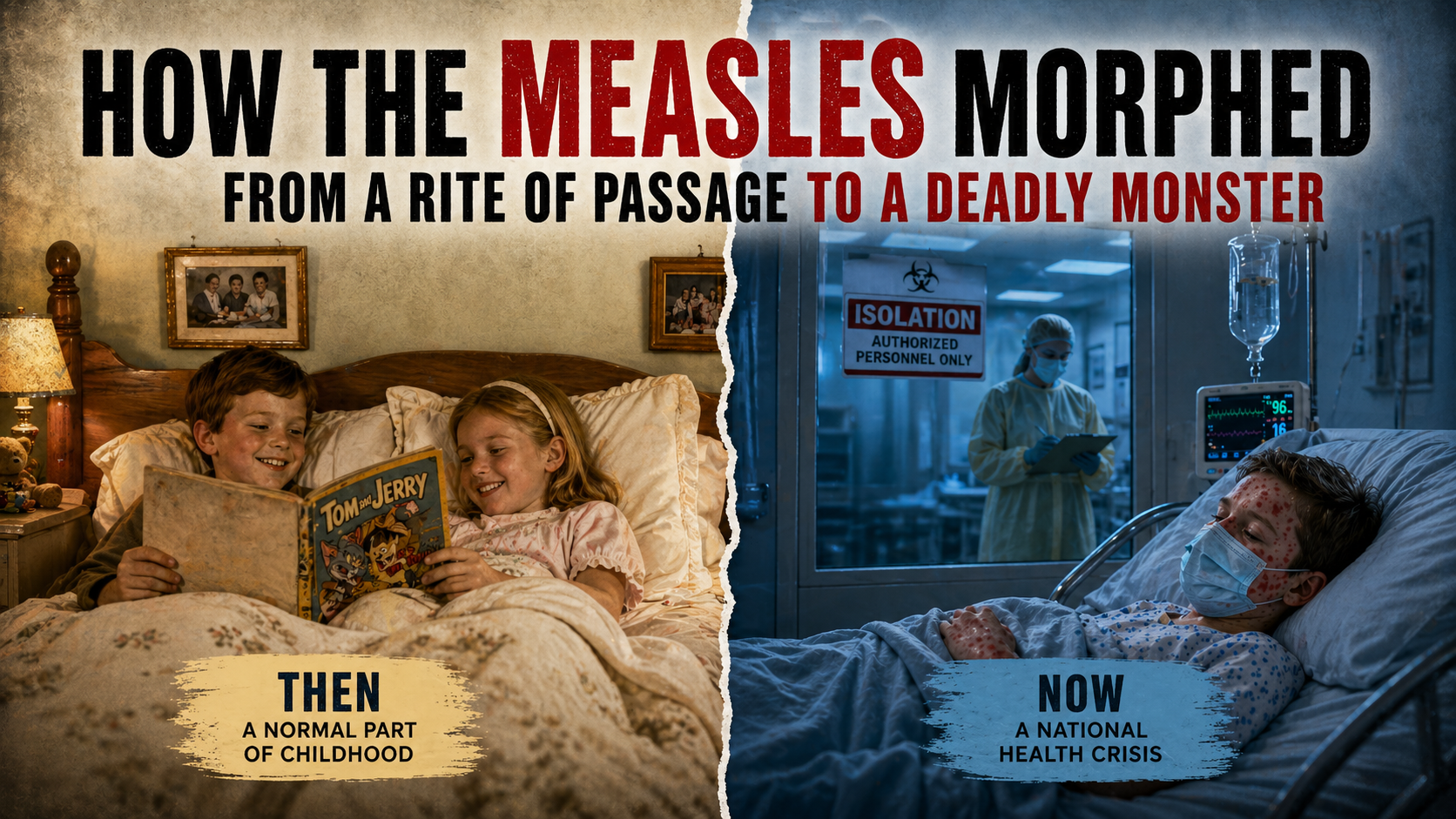
How has it come to pass that a childhood illness once seen as an unremarkable “rite of passage” has become a dreaded, dangerous disease that now requires national vigilance and emergency health measures?
Is this really a story of a normal illness that has morphed into a nationwide disaster, or is it an example of how public relations and marketing tactics are employed to shape public perception and justify ever more centralized, top-down health policies?
When the first measles vaccines were licensed in 1963, and in the years immediately following licensure, Americans showed little interest in measles inoculations. Instead, they considered the disease simply an uncomfortable aspect of early childhood.
A trip back in time offers a glimpse into how measles was perceived before the mass vaccination campaign and PR program were unleashed. Here are a few memorable television shows in which measles played a part:
- In The Donna Reed Show, there was a 1959 episode titled “April Fool” in which catching the measles was seen as a temporary inconvenience and was even used as a lighthearted plot device.
- In The Rifleman’s 1962 episode titled “The Princess,” Lucas and Mark discovered a young woman, Jennifer, and her younger brother, Charles, hiding in their barn. Charles was feverish and obviously unwell, so Doc Burrage was called in. To everyone’s relief, the good doctor confirmed the boy’s symptoms with these unworried words, “It’s just a case of the measles . . . he’ll be fine.”
- In the ever-sublime The Flintstones 1961 episode titled “In the Dough,” the measles was comically depicted as a “get out of the contest” card for Wilma and Betty and led to the classic sitcom trope of Fred and Barney dressing in drag to win a baking competition.
- And who can forget The Brady Bunch classic episode, “Is There a Doctor in the House?” In that 1969 portrayal of the measles, marked by silly sitcom humor, the red-spotted Brady kids stayed home and played games, in the middle of which Marcia declared, “If you have to get sick, you sure can’t beat the measles!”
Countless other examples (here, here, and here) from previous generations stressed that measles was a non-threatening condition that always ran its course in children. The main message conveyed to parents was that measles, like mumps and chickenpox—all of which were a nuisance—were something everyone just “got” and quickly moved on from.
The TV message, it turned out, was true. Those of us who lived through the measles in the 1950s and 1960s had the identical experience of Wilma and Betty and the Bradys: a bout with measles but no lasting consequences.
As conveyed in the final scene of The Brady Bunch, measles was seen not only as a nonissue for children but also for adults. The episode ends when Alice the housekeeper walks into the kitchen and the Brady dad, Mike, who had earlier had the measles, notices she appears to be “blushing.” Accompanied by the signature laugh track, Alice reveals that she isn’t blushing; she’s coming down with the measles herself.
But it wasn’t just pop culture that portrayed measles as a normal part of childhood, as nothing to fear.
Indeed, prior to the 1963 introduction of the measles vaccine, even pharmaceutical companies and public health entities in the United States described measles as a routine, mild, and unavoidable childhood illness. Educational materials during the 1950s and early 1960s focused on managing the disease—by recovering at home—rather than preventing it.
Educational pamphlets back in the day promoted the idea that children with measles could safely “enjoy” their time at home by taking a “bed rest and entertainment” approach. The illness was viewed as a standard part of childhood that could be endured with the help of a stack of children’s books, a floor full of toys, and a few days of patience. In fact, these brochures described measles as no more than a temporary “nuisance” and, if anything, a break from school rather than a medical emergency. Far from causing panic, the pamphlets had a calm, instructional tone.
So, we must ask: What changed from the days when measles were considered an occasion for a children’s house party to today’s portrayal of measles as a bioterrorism event? Were parents of the ’50s and ’60s (and before those decades) brutish, neglectful rubes who mindlessly watched their children waste away and ultimately perish with measles lesions all over their bodies? Did our young ones drop like flies from complications caused by this killer disease?
Hardly. Well-documented research on historical disease trends highlights that measles mortality in the US had already plummeted by more than 98% long before the 1963 vaccine made its appearance. The same research observes that this trend was driven by big improvements in the basic building blocks of life: better nutrition, better sanitation, and better overall standards of living.
Thus, something else must have driven the radical shift in perception: from seeing measles as a “routine” and short-lived childhood illness to regarding the by-then-uneventful ailment as a serious health threat.
Sure enough, the “something else” that shifted the public’s impression about measles was jump-started by a 1964 mini-documentary sponsored by vaccine manufacturer Merck. Its title: “Mission: Measles — The Story of a Vaccine.”
The widely distributed short film was billed as a public service announcement when in fact it was little more than corporate propaganda intended not to inform but to mold public opinion.
The announcer of this pharma docudrama conditions his audience to completely overhaul their view of measles. He tells them, “Many parents think of measles as just a common nuisance which makes their children feel miserable and keeps them out of school for a while. But physicians today know that measles is more than a nuisance.” Then he stokes parents’ fears by warning of potential complications, such as bacterial infections, fatal pneumonia, and brain inflammation.
It is clear, in retrospect, that “Mission: Measles” kicked off a deliberate communications strategy planned and executed by vaccine manufacturers and public health officials. Initiated in the early 1960s, the strategy continues to this day, more than sixty years later.
What could have been the primary motivation for this huge PR campaign?
All signs point to Merck’s desire to build support for mandated school vaccinations, thus ensuring a captured market for its product—a product Merck knew did not appeal to parents at that time. Obviously, the pharma company had watched in dismay when its measles vaccine languished after the 1963 licensure. Then, following a failed attempt in the latter half of that decade to induce massive uptake, pharma and public health officials must have realized that the only way they could succeed in their quest for mass measles inoculation was to reconfigure in their marketing literature the legitimately called “mild” disease into a “serious and frightening” disease.
When their campaign for voluntary uptake failed, public health officials switched to “legal solutions” in the form of school mandates. States began passing laws requiring proof of vaccination for school enrollment. Doing so guaranteed coverage of what were dubbed “hard to reach” populations.
By 1969, seventeen states had school laws mandating “prevention” of measles. By 1980, all fifty states had implemented mandates requiring proof of immunization (or history of disease) before a child could be enrolled in a public school.
Meanwhile, the 1977 Childhood Immunization Initiative set the goal of raising vaccination rates to 90% within two years. The initiative involved reviewing approximately 28 million school records to identify children who were missing doses and refer them to health clinics and pediatricians’ offices for vaccination. All the states strictly enforced these laws, even when it meant excluding from school the students whose parents didn’t comply.
Along with creating a captured market for Merck’s unpopular vaccines, the 1977 initiative triggered a major surge in federal subsidies for private vaccine manufacturers. The significant increase in subsidies and grants during this period allowed state and local health departments to purchase vaccines at scale from private manufacturers like Merck.
Beyond creating a captured market financed by public monies for private gain, the 1977 Childhood Immunization Initiative also included a media strategy that explicitly used fear-based rhetoric as a tool to scare parents into submission. As if all this government support were not enough, Congress would later pass The National Childhood Vaccine Injury Act of 1986 (NCVIA), which provided a massive liability shield to Big Pharma and eliminated the possibility of market forces improving vaccine safety. Instead, the NCVIA incentivized the vaccine industry to manufacture still more shots—all liability-free.
This media strategy would consist of an overt campaign of “cripple and kill” messaging and vivid visuals of children who were supposedly blinded or brain-damaged by measles. The campaign was manufactured to drive home the point: “These are the wretched conditions we shall return to if we don’t improve our immunization rates.” Journalists and broadcasters were encouraged to use provocative language to pierce through what they perceived as public indifference. Their “reporting,” full of flagrant bias, was designed by the powers that be to intimidate parents. In shilling for pharma, the news media went so far as to insist that their message was meant to be scary-sounding as a strategy “to save lives.”
Gone were the days when TV sitcoms offered up a house party chuckle fest of board games and “off” days from school. Those days were replaced by today’s full-blown public health crisis—with apocalyptic consequences for anyone who dares challenge Big Pharma’s contrived measles-mania narrative.
A legitimate question: Why the imperative to re-brand this disease, depict it as dangerous, and thus incite mortal fear of it?
The easy answer: Fear sells. Fear sells the product. Fear sells the mandates. And fear is what politicians and their corporate controllers rely on when they outright lie in an attempt to control the populace.
In sum, the decades-long, massive, methodical, manipulative, and malicious campaign to turn measles into a monster was never about public health. It was always only about manufacturing consent for a narrative. But the public appears to finally be waking up to the fact that they’ve been duped. Duped not just about measles but about the entire vaccine campaign. Yes, we can expect more of the same from the pharma fear factory. Now, however, we’re much better prepared to not fall for it.