Visit our Re-post guidelines
“What hope is there for medical science to become an actual science when the entire structure of medical knowledge is built around the idea that disease is an entity that can be expelled when the right drug is found?”
— Health Epigrams by John H. Tilden, MD (1851–1940)
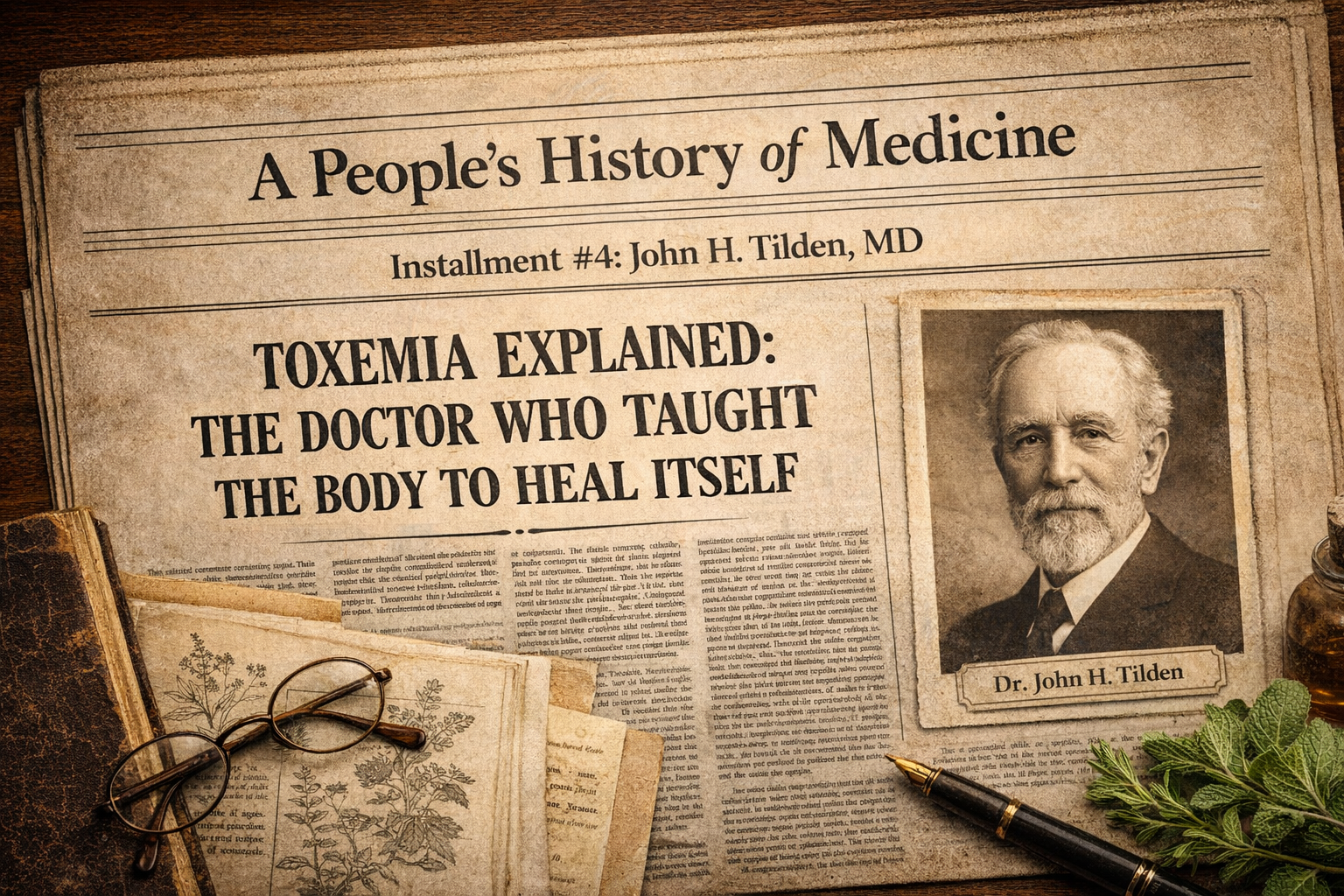
John Henry Tilden was born on January 21, 1851, in the Illinois hamlet of Van Burensberg. His parents, Joseph and Ann, presumably didn’t have to pay doctors’ bills to have good health care for John and their eight other children: Joseph G. Tilden, MD, you see, was an allopathic physician. The family likely avoided veterinarian bills, too, since, from childhood, John had a predilection for practicing medicine, as best he knew how, on animals. His patients included household pets (dogs and cats) and farm animals (calves, pigs, and birds).
Not surprisingly, the “boy doctor,” as he was called, aspired to follow in his father’s footsteps and, indeed, began studying medicine as a young teen under his father’s supervision. Then, at the age of seventeen, he began a two-year apprenticeship in the office of Dr. J. Fellows in nearby Nokomis, Illinois.
During these early years, John was not fully convinced of his father’s medical methods, for there was little evidence of patients regaining their health. The discrepancy between what they were paying for and what they were receiving in the way of help piqued John’s interest in alternative medical methods and motivated him to enter the Eclectic Medical Institute of Cincinnati, Ohio. The institute had been founded in 1845 as a protest against the allopathic schools of medicine of that time. (Its name was changed to the Eclectic Medical College in 1910.)
Eclectic medicine was a 19th-and-early-20th-century American movement that sought to provide healing remedies in harmony with the body’s natural curative properties while avoiding harsh methods like bloodletting and the use of mercury.
Allopaths of the day—including, presumably, Tilden’s father—prescribed frequent and large dosages of calomel, a white, tasteless mineral compound of mercurous chloride that was one of the most popular and controversial medicines of the 18th and 19th centuries. They also used, with equal frequency, the so-called “heroic” bleeding technique. By contrast, the Eclectic movement, founded by Dr. Wooster Beach, relied largely upon plant-based, natural treatments and emphasized patient-centered, holistic care—although they did not wholly reject what was already deemed “conventional medicine.”
The natural treatment concepts adopted by the Ecletics were antithetical to the well-funded allopathic industry, which widely viewed high doses of calomel as a “cure-all,” when it was actually a toxic form of mercury. This standard practice of high dosages of calomel led to severe mercury poisoning. It caused patients to lose teeth, to vomit, to undergo extreme cramping, and to have bloody diarrhea. In fact, for some unfortunate patients, the “modern” mercury treatment resulted in permanent facial deformities and even death. However, allopathic doctors took these symptoms as a sign that the calomel was “working”—was purging the system of the disease.
The Eclectics not only rebelled against invasive medical modalities but also sought to reflect certain democratic principles of a young nation. In other words, they were determined to develop a distinct American materia medica. Their people-centered philosophy stood in stark contrast to the mushrooming allopathic medical system that evolved into today’s colossal for-profit leviathan.
Upon graduating from the Eclectic Medical Institute in 1872, Tilden returned to his Illinois roots and began practicing medicine in Nokomis, where he would work for eight years. He then moved to St. Louis for post-graduate work at the American Medical College, where for two years he lectured on anatomy and physiology.
In 1881, he partnered with Dr. R. F. Bennett in neighboring Litchfield. There, he built an extensive practice, while periodically returning to the college in St. Louis to teach anatomy. During this time, Dr. Tilden traveled between two places more than just geographically. In his professional life, too, he seemed to be ideologically suspended between the two places: allopathic “heroic” medicine on the one hand and naturopathic medicine on the other.
In 1886, Tilden moved westward, to Wichita, Kansas, where he built a lucrative practice and a considerable reputation for his “thorough knowledge of medicine, and skill in surgery.” Increasingly disillusioned with drug-based treatments, Dr. Tilden would eventually abandon them altogether in favor of approaches that emphasized the body’s self-healing capacity.
“From time immemorial, man has looked for a savior; when not looking for a savior, he is looking for a cure. He believes in paternalism. He is looking to get something for nothing, not knowing that the highest price we ever pay for anything is to have it given to us. Instead of accepting salvation, it is better to deserve it. Instead of buying, begging, or stealing a cure, it is better to stop building disease. Disease is of man’s own building, and one worse thing than the stupidity of buying a cure is to remain so ignorant as to believe in cures.”
— John H. Tilden, MD, Toxemia Explained: The True Interpretation of the Cause of Disease(1926)
In 1890, Dr. Tilden left Wichita and moved even further West—this time to Denver, Colorado, where he finally fully committed himself to promoting a more natural approach towards health and healing. At the same time, he explored and synthesized different ideas about enervation and toxemia as root causes of impaired health.
In Denver, Dr. Tilden was influenced by natural hygiene pioneer Dr. Isaac Jennings and hydrotherapy and nutritionist pioneer Dr. Russell T. Trall—so much so that he became a leading critic of the “drugging” medical system. He argued that health could only be restored by removing the causes of “toxemia” rather than treating symptoms with pharmaceuticals. The pioneering practices of Jennings and Trall, along with Tilden’s extensive reading of medical studies from European medical schools, his voluminous personal experiences in the medical field, and his own critical thinking led him to once and for all reject the conventional characterizations of disease and the use of medicines to cure illness.
He came to understand that every so-called disease is a crisis of toxemia—the retention of excessive amounts of waste products (toxins) in the blood, resulting in enervation.
“The study of disease per se leads to chaos. Only knowledge of health — the study of health — can give true knowledge of disease, for disease is handicapped health.”
— Health Epigrams by John H. Tilden, MD
From the start of his Denver practice, Tilden used no medicine, instead focusing on clearing the body of toxic waste and teaching patients how to live in harmony with natural laws to maintain a healthy body. Integral to his philosophy was teaching patients how to live so as not to produce toxic conditions—and to instead create a healthy body free of disease.
In 1896, Dr. Tilden began publishing a monthly magazine called The Stuffed Club as a means of spreading his ideas on health and healing. In 1915, he changed the magazine’s name to The Philosophy of Health and then changed it again in 1926 to Health Review and Critique. The magazine would attain wide circulation in the United States and abroad. But, because Dr. Tilden refused all advertising, it never produced revenue.
During the pneumonia epidemic of the early 1900s, it was noted that Dr. Tilden had the highest success rate in healing pneumonia of any other medical man of the era. While hundreds of patients of other physicians were succumbing to the deadly disease, Dr. Tilden was said to have never lost a patient, despite having more pneumonia cases than any other doctor in the country. His treatments, distinctly different from his allopathic peers, were in accordance with his belief that the body’s natural healing mechanisms would remedy the illness once the proper conditions for healing were created.
Among Tilden’s practices in curing pneumonia:
- He used no drugs.
- He cleansed the colon of each patient.
- He used water therapy.
- He administered natural live foods.
His success was considered miraculous because most other doctors relied on drugs and consistently failed to heal their patients.
Dr. Tilden would establish his first formal sanitarium, the Tilden School for Teaching Health, in Denver in 1916. He operated the school at its peak for eight years, housing up to eighty-five patients and employing a staff of thirty. After selling his interest in the original school, he left the institution and opened a second operation, the Tilden Health Institute, in East Denver. He oversaw that school from 1926 until his death in 1940.
Best known for his seminal work, Toxemia Explained: The True Interpretation of the Cause of Disease, Dr. John H. Tilden was a prolific author, an astute observer, and a profound intellectual. He wrote at least fifteen major books and specialized medical texts in addition to editing several long-running health journals. His vast literary output can be found here.
His influence on alternative health movements is recognizable, even to this day. His ideas have empowered individuals to reject the drug dependency of what’s called “conventional medicine” in favor of self-care strategies focused on diet and detoxification, holistic prevention, and toxin-free living strategies that focus on the body’s innate healing capacity.
Health advocate Henry G. Bieler, a fellow physician, credits Tilden’s writings on toxicity for shaping his own nutritional and endocrinological approaches in Food Is Your Best Medicine (1965).
“There is but one tonic, and that is food — a rightly adjusted diet — encouraged in its assimilation by sunshine, fresh air and exercise.”
— Health Epigrams by John H. Tilden, MD
Similarly, the toxemia concept was adapted by Harvey and Marilyn Diamond in their 1985 bestseller Fit for Life, which re-framed Tilden’s notions of bodily toxicity from dietary indiscretions such as “metabolic imbalance.”
In the 21st century, Tilden’s works have experienced a digital revival through platforms like Project Gutenberg and the Internet Archive, making texts such as Appendicitis: The Etiology, Hygienic and Dietetic Treatment (1917) freely accessible and sustaining interest in his anti-pharmaceutical stance within online wellness communities. His biography can be found here: https://www.healthscience.org/dr-john-h-tilden-biography.
Beyond being a hidden historical figure whose work is now coming to light, Dr. John H. Tilden should be recognized as a much-needed “antidote to fear, frenzy and the popular mad chasing after so-called cures.”