“Our worst epidemics now are epidemics of vaccination in which more people are killed every year by “vaccinal diseases” than by the diseases that the vaccinations were supposed to combat.”
— Preface, The Poisoned Needle: Suppressed Facts about Vaccination, by Eleanor McBean, (c) 1957
Visit our Re-post guidelines
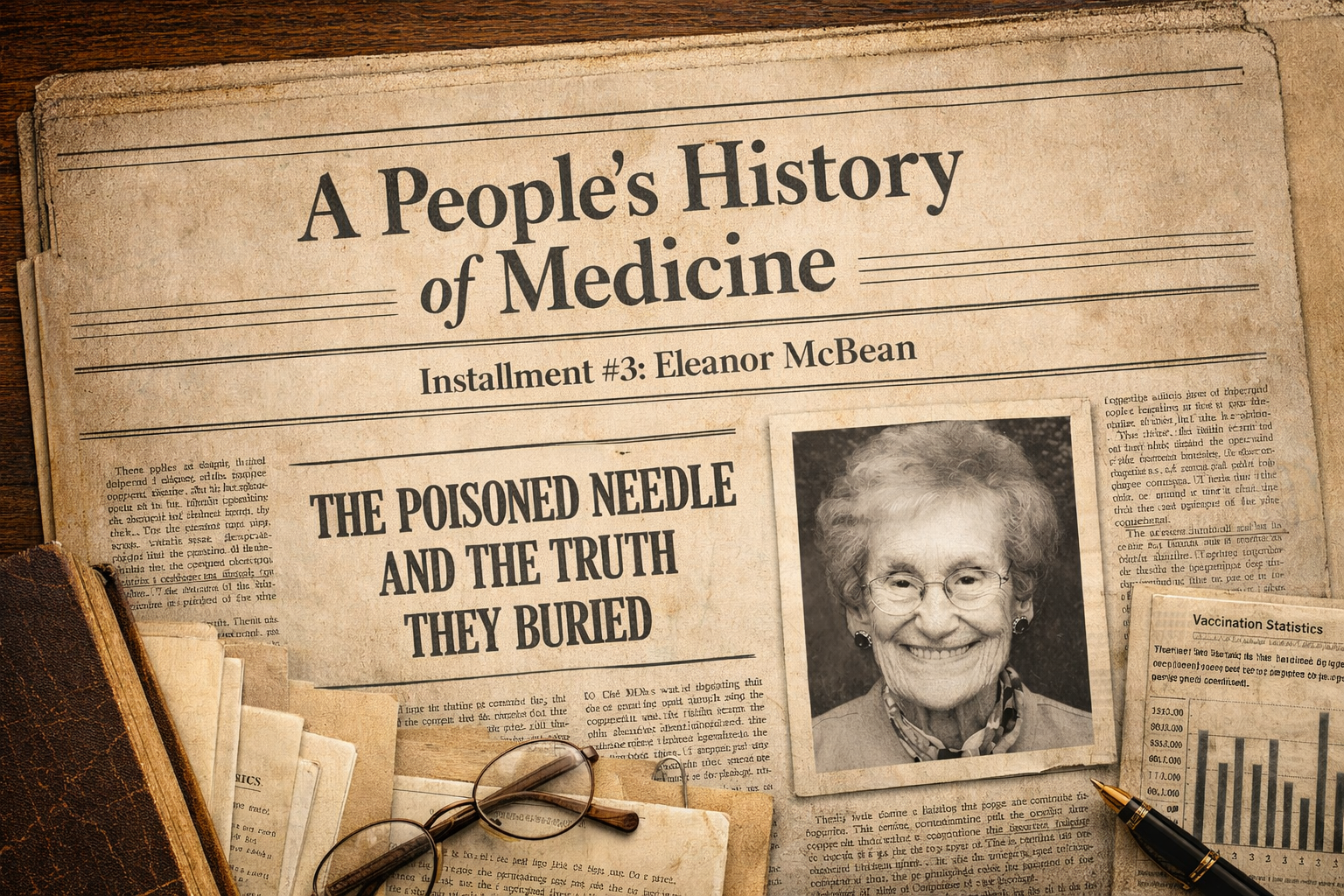
Eleanor Illiaud McBean (1905–1989) was an American author and prominent anti-vaccination activist who challenged mainstream medical practices during a time when public health initiatives were rapidly expanding.
She was a significant figure in the natural health and anti-vaccination circles of Los Angeles during the 1950s. Her research laid the groundwork for much of today’s alternative health culture, which prioritizes natural foods and remedies over the synthetic modalities of mainstream medical intervention.
McBean, who also went by “Eleanora McBean” or “E. McBean” and sometimes used the pseudonym “Elben,” is the author of several books on vaccines. The best known of these is an anti-vaccination foundational text titled The Poisoned Needle: Suppressed Facts About Vaccination, published in 1957.
Other works by McBean (written under her various names) include:
- “The Hidden Dangers In Polio Vaccine” (originally Chapter 10 of The Poisoned Needle and subsequently published as a stand-alone booklet);
- Answers For The Worried Smoker (by Eleanor McBean, published in 1962);
- Vaccination The Silent Killer: A Clear and Present Danger (co-authored by Ida Honorof and E. McBean, published in 1977);
- Swine Flu Expose (by Eleanora McBean, Ph.D., N.D., published in 1977); and
- Vaccination Condemned by all Competent Doctors (by Elben, published in 1981).
What makes Eleanor McBean such an important and compelling figure in the annals of health freedom circles is her significant achievement that surpasses the standard image of an anti-vaccine activist. To wit: Although she was not the first to criticize the theory of inoculation (many had been doing so since its inception) and would not be the last or the best-known critic, McBean was one of the first, if not the very first, to compile a cogent and convincing collection of anti-vaccine documents into a single book. Her accomplishment should not be minimized, especially since women were generally unacknowledged in the field of medicine back then.
Furthermore, not only did McBean dare to challenge the entire foundation of vaccination, she stood up to the juggernauts of pharmaceutical interests, regulatory agencies, and the monopolizing medical industry at a time when they were all going full throttle with extensive immunization campaigns and aggressive attacks against opponents. Amidst this viper’s nest of vested interests and government directorates, McBean’s critiques were not timid appeals for consideration. Rather, they were uncompromising salvos against the entire allopathic healthcare system.
In the Preface to her preeminent book, The Poisoned Needle, McBean concluded:
“Vaccination, instead of being the promised blessing to the world, has proved to be a curse of such sweeping devastation that it has caused more death and disease than war, pestilence, and plague combined.”
The author then went on to document her strong claim by laying out overwhelming evidence in each of the book’s ten chapters. She presented an archive of charts, statistics, testimonials, and medical data dating back to the 1880s, proving that sanitation, nutrition, and social reforms—not vaccinations—were the driving forces behind the immense reduction of infectious diseases.
This copious documentation enabled her to not only expose the medical subterfuges used to legitimize immunization but also to chronicle the political and financial deceits that accompanied the vaccination program every step of the way.
But Eleanor McBean was more than just a brilliant researcher and critic of the medical system. Even more importantly, she was a lifelong advocate for better ways of achieving individual and collective health: through sanitation, proper nutrition, clean air and water, economic security, and by creating social circumstances that allowed individuals and entire families to be free from debilitating habits.
Today, we herald McBean for having boldly taken the position that vaccination is a medical deception driven by politics and profit and for having publicly proclaimed her belief that the medical profession ignores true causes of disease in favor of political gains and financial profit. Her legacy lives on through her actions and through her words, which rang true in her day and ring just as true in ours:
“For the past 2,000 years physicians have been looking in the wrong direction for the cure of disease. Their worse than useless practice of killing germs with poison drugs has never — can never — solve the problem of disease.”
It’s been 70 years since her influential book, The Poisoned Needle, was published. Now that the vaccination schedule has metastasized into its current horror, that book, along with the rest of her writing, is more relevant than ever.
Eleanor McBean’s work has been revived and republished in various editions, including reprints by Health Research Books (1993, 1998) and digital versions. Though some of these publications are hard to find, most of them are available (and The Poisoned Needle is accessible) for free here.
Author’s Note: In all my years of writing and research on various topics and on numerous individuals, I must admit that finding information on the woman named Eleanor I. McBean has been more challenging than any other instance I can remember. Her work is fairly accessible, but details on her personal life are few and far between.
For those of you who have in your possession McBean’s most famous book, The Poisoned Needle, it is likely you imagine her to have been a stately African-American woman looking like the photograph on the book’s back cover. However, that picture is apparently of Eleanor O. McBean, who lived in New Jersey (not in California) and who died in 2017 (not in 1989).
It appears that Eleanor I. McBean, author of The Poisoned Needle, was a white woman of which little is known—at least to this author, even after extensive digging. Curiously, the article you are reading now might be one of the first published pieces to have brought this apparent mix-up of McBean’s identity to readers’ attention.
In some ways, I find this unusual aspect of Eleanor McBean’s story the most compelling. It reminds me that even after someone who has been little recognized—or even incorrectly recognized by the wrong photo—passes from earth, the valuable ideas brought to light by that person continue to live on.