Visit our Re-post guidelines
INTRODUCTION
No sooner has the ink begun to dry on the Hantavirus House of Horrors story spun by Big Media in April and May than into the spotlight steps another “global health emergency.” The new scare has quickly turned yesterday’s trumped-up tale into a fast-forgotten memory.
Enter . . . Ebola.
Why the sudden switcheroo from one viral disease to another?
Perhaps polls were showing that the hanta hype hadn’t succeeded in stirring the collective imagination?
Or maybe fear fatigue had set in, and the public was sick and tired of Big Pharma schemers crying wolf?
What’s more likely, however, is that traders who bank on making money from human phobias rejected the notion that the hunt for hanta would offer them the necessary return on investment. They required another threat—one much more sensational and alarming than humdrum hanta—to stoke folks’ fear. Surely a bigger bogeyman would unlock the door to vast money flows.
So, an updated version of “Ebola” was rolled out to replace the unimpressive hanta fable. Accounts of the Bundibugyo ebolavirus (BDBV) in the Democratic Republic of the Congo (DRC) and in Uganda hit the world media circuit in late April, ramped up in mid-May, and, as of early June, are going full steam ahead.
The “Ebola” yarn is far more involved and indispensable to the corridors of power than some of the lesser microbial manipulations and maneuvers that were performed, such as the hanta hoax. “Ebola,” unlike hanta, entails much more than ordinary disease-mongering, pharma racketeering, and the usual intrigues surrounding large-scale medical deceptions.
An accounting of the decades-old “Ebola” mythos isn’t complete without mentioning:
- The colonial Scramble for Africa;
- Public health imperialism;
- The questionable involvement of non-government organizations (NGOs);
- Toxic mining operations;
- Firestone rubber plantations;
- Banned pesticide dumping in Africa;
- The coating of West African homes with poisonous insecticides;
- Highly toxic beta-lactam antibiotics;
- Toxic vaccine campaigns;
- Numerous conditions that plague Africans every day—that so-called Ebola epidemics serve to camouflage—such as contaminated water, poor sanitation, severe malnutrition, and brutal working conditions.
The current Ebola chronicle, though framed in the narrative of the pandemic industrial complex, is in fact an immense and complex mission that is being used to disguise transgressions committed by multinational corporations so they can achieve other, more obscure objectives.
Our multi-part exposé will unmask those “other, more obscure objectives.”
It will also present a comprehensive picture of the entire Ebola saga. In so doing, it will uncover and detail the illusions, the subterfuges, and the smokescreens that the authorities have concocted to fool us and scare us and get us to submit to their control.
In sum, it will reveal the harsh, hidden realities of how we got here.
Everything we’ll be writing about began long before what has been named “Ebola” even existed.
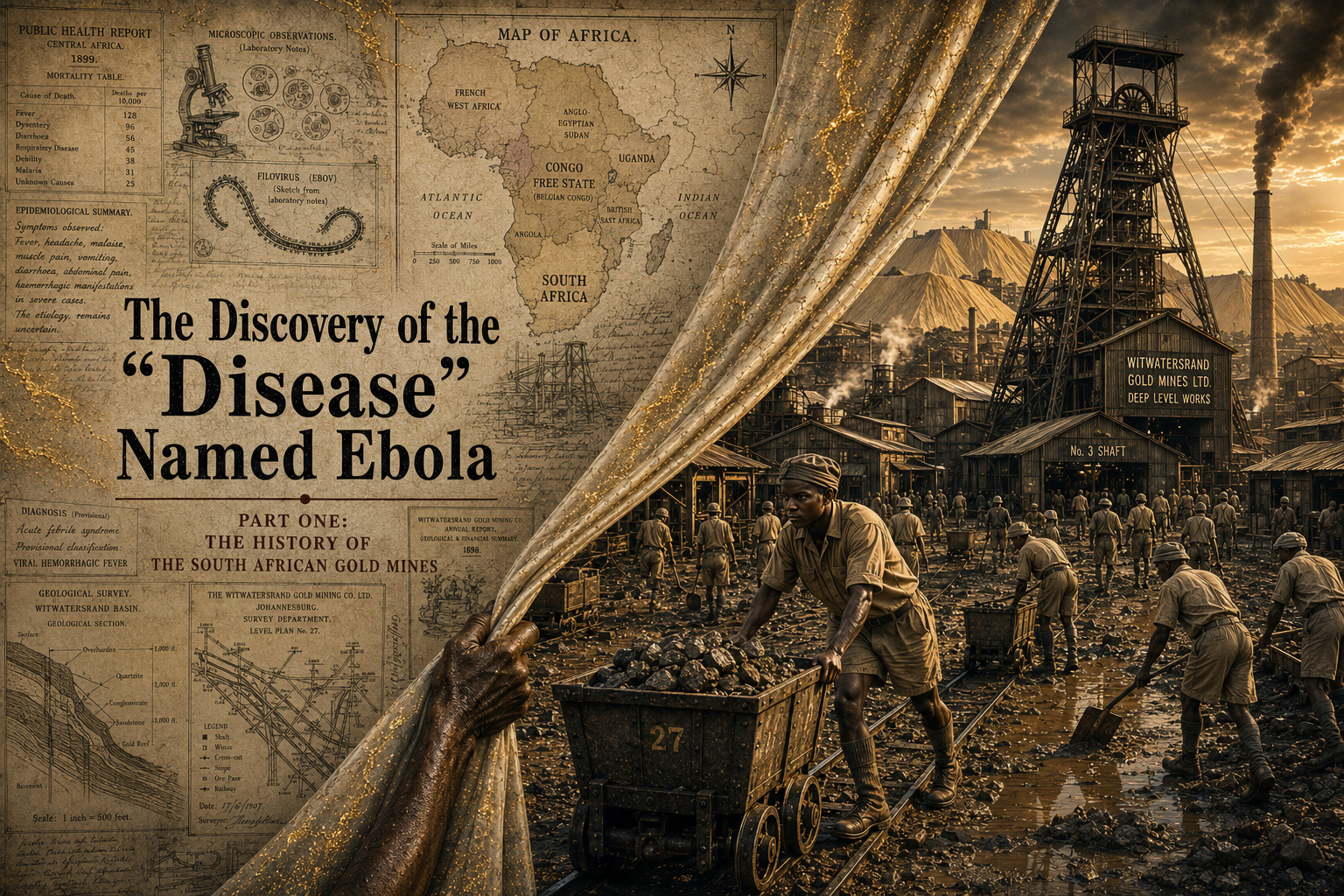
Part One: The History of the South African Gold Mines
“You have to know the past to understand the present.” ― Carl Sagan
The Witwatersrand Basin in South Africa is famous for being the most productive goldfield in human history. It has produced an estimated one-third to one-half of all the gold ever mined in the world.
Inspired by the billions-of-years-old Archean rivers, deltas, and channels that created picturesque waterfalls flowing over the quartz rock escarpment, the name “Witwatersrand Basin” comes from the Dutch Afrikaans words that translate as “Ridge of White Waters” in English.
The discovery of gold in 1886 by itinerant prospector George Harrison near modern-day Johannesburg triggered the historic Witwatersrand Gold Rush. Johannesburg was transformed from a temporary tent camp into a bustling financial and industrial metropolis.
Not surprisingly, Johannesburg soon became known as “the City of Gold.” Also not surprisingly, the South African currency, the “rand,” would be named after Witwatersrand’s last syllable, which means “ridge.”
The Witwatersrand region in northeastern South Africa, and specifically its gold mining industry, has for decades formed the backbone of that country’s economy and has influenced financial systems worldwide. Today, Johannesburg remains South Africa’s wealthiest and largest city.
In the early days of the gold rush, the miners relied entirely on open-pit and surface methods of extraction. That’s because the gold was visible on the surface of the conglomerate rock. Early prospectors could literally walk up to exposed rock outcroppings, break off pieces of the rock, crush the pieces, and sift out the gold. The first miners dug shallow trenches and open pits and used basic hand tools to find the visible gold veins just beneath the soil.
But surface mining didn’t last long. Within just a few years, the easily accessible surface gold deposits were depleted and eventually exhausted. Mining companies had to shift from simple above-ground digging to deep-level underground shaft mining to access rich mineral veins.
The gold mines were constructed to follow the downward-dipping rock layers, ultimately creating some of the deepest, most extreme mining operations in the world.
By 1910, the average depth of South African gold mines was about 1,100 feet, and pioneering operations were pushing past 4,000 feet. Today, South African gold mines are the deepest mines in the world. The Mponeng Gold Mine holds the record at roughly 2.5 miles beneath the Earth’s surface.
As large-scale gold extraction accelerated in the late-19th and early-20th centuries in the ultra-deep gold mines of the Witwatersrand Basin, it gained a reputation for being one of the most dangerous mining regions anywhere, ever.
Between 1912 and 1994, more than 69,000 South African gold miners died in workplace accidents. But that “official” death toll from accidents vastly undercounts the total loss of life. Omitted are hundreds of thousands—likely more—deaths caused by occupational illnesses stemming from the inhumane conditions the miners faced every day.
Purposely providing substandard, barbaric living conditions was a deliberate economic and social strategy the Witwatersrand gold mine owners and the South African government employed to maximize profits. By treating Black workers as temporary units of cheap labor, the mining industry built a system of intense deprivation.
The Witwatersrand mining camps were overcrowded to the extreme. Up to fifty men were crammed into a single, small concrete room. They slept on stacked, narrow bunks—prison-style. There was little ventilation, no electricity, and such poor heating that the only way the miners survived the bitter-cold winters was to stuff the wall cracks with rags. The bathroom facilities were basic, unhygienic, and shared by hundreds of workers. Their floors were frequently washed down with cold water, leaving them perpetually damp.
Drinking water was generally scarce, frequently contaminated, and stratified by race. Surface camps could rely on potable water from the South African utility company Rand Water, whereas miners working deep underground in severe dust and heat were forced to drink contaminated, stagnant water. Pooling in the rock formations, this water was frequently polluted with runoff from mine shafts.
Food quality was notoriously terrible—often described by miners as “not fit for a dog.” The Chamber of Mines strictly regulated dietary rations across all Witwatersrand compounds. Workers were rationed about five pounds of mealie-meal (a coarsely ground maize flour cooked into a thick porridge, or pap) and two pounds of meat per week. The portions didn’t meet even the bare minimum caloric needs of men who had to perform ten to twelve hours a day of grueling, heavy physical labor in extreme underground heat.
Because mining companies bought food in massive quantities at the lowest possible bulk rates, what was served to the Black miners was usually rotting and contaminated. The grains, regularly “mouldy and musty” and riddled with live weevils, should’ve been labeled: “Not for human consumption.” The small meat ration was often composed of the cheapest, toughest offal and maybe parts of heads and other scraps that were on the verge of spoiling.
The utter absence of fresh fruit and green vegetables meant the miners’ diet lacked Vitamin C and essential nutrients. Indeed, thousands of Witwatersrand workers developed scurvy, which rotted their gums, created open sores on their bodies, and caused their joints to bleed and swell under the strain of laboring underground.
Such a surfeit of unhealthy conditions was surely misery-inducing to those poor miners.
But it gets worse. Extreme thermal shock brought on by sudden exposure to a dramatically different temperature was common—and dangerous.
For example, in the wintertime, after miners had sweated through a long shift in sweltering underground shafts deep under the Witwatersrand reef, they were brought to the surface. Clad only in light clothing, their bodies abruptly encountered freezing temperatures and whipping winds on the Highveld, South Africa’s high-altitude plateau.
But perhaps the most deadly of all of the conditions they faced was inside the mines. Daily inhaling the fine silica dust from blasting Witwatersrand quartz caused widespread silicosis (lung damage), which often proved fatal. Official autopsies have been found on the miners of that era who worked in the wider Transvaal region. Their autopsies showed the average age of death for high-risk workers was around 36 years old.
There were untold thousands of other ill mine workers who returned home to rural South Africa, Lesotho and Mozambique and whose deaths went unrecorded by official mine statistics. Their numbers and the manner and cause of their deaths were covered up in numerous ways.
One way to lower “on-site” mortality data was through the repatriation system. When a migrant worker became too sick with terminal silicosis to perform physical labor, mine management canceled his contract and sent him, via train, to either an impoverished rural reserve or a neighboring country to wither away and die. Of the miners who were repatriated, nearly half were dead within a year, and 60% died within two years.
By forcing the rural peripheries of their operations to absorb the medical and economic burden of terminal illnesses, the mining companies successfully kept their on-site mortality figures lower than the actual occupational toll.
Another of their insidious tactics involved weaponizing pseudoscientific racial theories. That is, they blamed the catastrophic impacts of the unsafe mine work and living conditions on the biology and genetics of Black miners.
Early medical researchers and industry scientists on the Witwatersrand were enlisted to promote the prevalent racist theories of the day, which today we call “dysgenics.” Black bodies were deemed to be inherently defective, fragile, or unevolved. This bias allowed mine owners to evade legal and financial liability for the toxic dust, rotten food, and disease-riddled “residences” they provided for the workers.
Prominent mine doctors asserted that Black people possess smaller lung capacity, a weaker respiratory structure, and a primitive lymphatic system that absorb dust and disease at higher rates. This propaganda allowed the Chamber of Mines to argue that miners’ deaths were an inevitable biological tragedy rather than the result of underground exploitation.
When dysgenics proved insufficient to ward off accusations of abuse of mine workers, the industry titans and the colonial-era authorities utilized the recent discovery of Mycobacterium tuberculosis (TB) bacteria to shift the responsibility for worker deaths away from the brutal working and living conditions in the mines. TB is alleged to be a slow-growing, aerobic bacillus (a genus of bacteria) that can cause lung scarring, respiratory failure, and death, if left untreated.
So, here we have thousands upon thousands of migrant laborers suffering unremittingly in poorly ventilated mines, breathing in silica dust and thus being subjected to silicosis (permanent lung damage), and now they’re being outright blamed for their own immiseration and for fueling a massive TB epidemic.
Here are a few of the era’s “arguments” against the Black race:
- Medical journals argued that Black miners “contracted” TB because of their “primitive hygiene,” their supposed lack of intellect regarding sanitation, and their brutish tribal customs.
- The same journals argued that because indigenous Black Africans had historically lived in rural isolation, their ancestral lineage had never been exposed to tuberculosis, leaving them without any “hereditary immunity” or genetic resistance to the tubercle bacillus.
- A 1932 landmark report titled Tuberculosis in South African Natives, published by the South African Institute for Medical Research—and heavily funded by the mining industry—argued that Black Africans possessed an innate, racially distinct biological reaction to TB. It also claimed that Europeans had evolved a genetic ability to cleanly localize the infection in their lungs.
In essence, the 1932 report pushed the pseudoscientific belief that the “inferior” Black body was biologically incapable of containing TB, and was thus subject to rapid, systemic organ collapse, while the “superior” European body could internally render the bacterium harmless.
By categorizing the disease as a “racial pathology,” the report explicitly eliminated the roles played by cramped slave quarters, poor nutrition, open latrines, poisoned water, and silica dust exposure.
It also ignored the fact that White miners were given supervisory roles in rooms that were well-ventilated and at normal altitudes, were served better rations, and had sanitary living quarters, whereas Black miners were forced to do the actual drilling in unventilated, high-density spaces amid toxic dust clouds and without respirators.
The most insidious aspect of the report, beyond inventing this bogus belief of racial inequality, was the sleight of hand that inserted a newly “named” disease and “the spread” of that disease into the narrative. The combination of the brutal underground and squalid above-ground conditions had created a perfect storm for a fatal illness (silicosis) to be conveniently “disappeared” and for another fatal illness (tuberculosis) to be conveniently incriminated by this magic act.
Gaslighting, mercilessness, and even malevolence were commonplace among the mercenary mine owners.
And to what end? All of these pseudomedical and social deceptions served a massive economic purpose: saving the giant mining houses billions in compensation costs.
After 1911, if a miner died of silicosis, the mine was legally required to pay a payout or a pension. In reality, whether or not this compensation was paid largely depended on the miner’s race. White miners received both pay and sanatorium care. Black African miners, by contrast, were more often than not deemed expendable, denied benefits, and repatriated to rural villages to die.
However, if a Black miner died of tuberculosis, the mining establishment argued that TB was a “natural, biological disease” stemming from the worker’s own genetic vulnerabilities.
Question: How did this hocus-pocus play out in the Witwatersrand gold mines in the early-20th century?
Answer: Mine operators and industry-backed medical panels aggressively blamed the staggering mortality rates among Black miners exclusively on tuberculosis (TB) and a supposed “racial susceptibility” to infectious respiratory pathogens. Thus, they evaded paying occupational disease compensation to tens of thousands of dying workers for nearly a century.
Through this historical lens, we can see the blueprint of institutional duplicity and denial. We can also see the beginnings of how the medical and scientific establishments have become intertwined with corporate interests.
In our above illustration, by framing the barbaric social crimes in the Witwatersrand as a biological outbreak, mining entities and their institutional backers effectively shifted legal and financial liability away from their own oppressive operations, away from their own industrial pollution, and onto false genetic factors or invented pathogens. This tactic has served as the template for several historical case studies and has expanded in scope in the 21st century.
It’s not just avoiding liability and disguising the conditions on the ground that matter in the aforementioned corridors of power. The people in power place even more importance on the way a “crisis” is defined—because that definition will dictate where the money flows. When they frame global health crises through the lens of their own choosing, the financial outcomes for major investors shift dramatically in their favor.
Once the systemic horrors of poverty, toxic pollution, and exploitation are swept under the rug by diverting the blame to pathogens, multiple additional lines of exploitation are created.
As we’ll see, the history of “Ebola,” including this latest “outbreak,” involves virtually all sectors of political and public life on both a national and an international stage.
This is Part One of our Ebola Series. Read Part Two | Part Three. Stay tuned for Part Four.