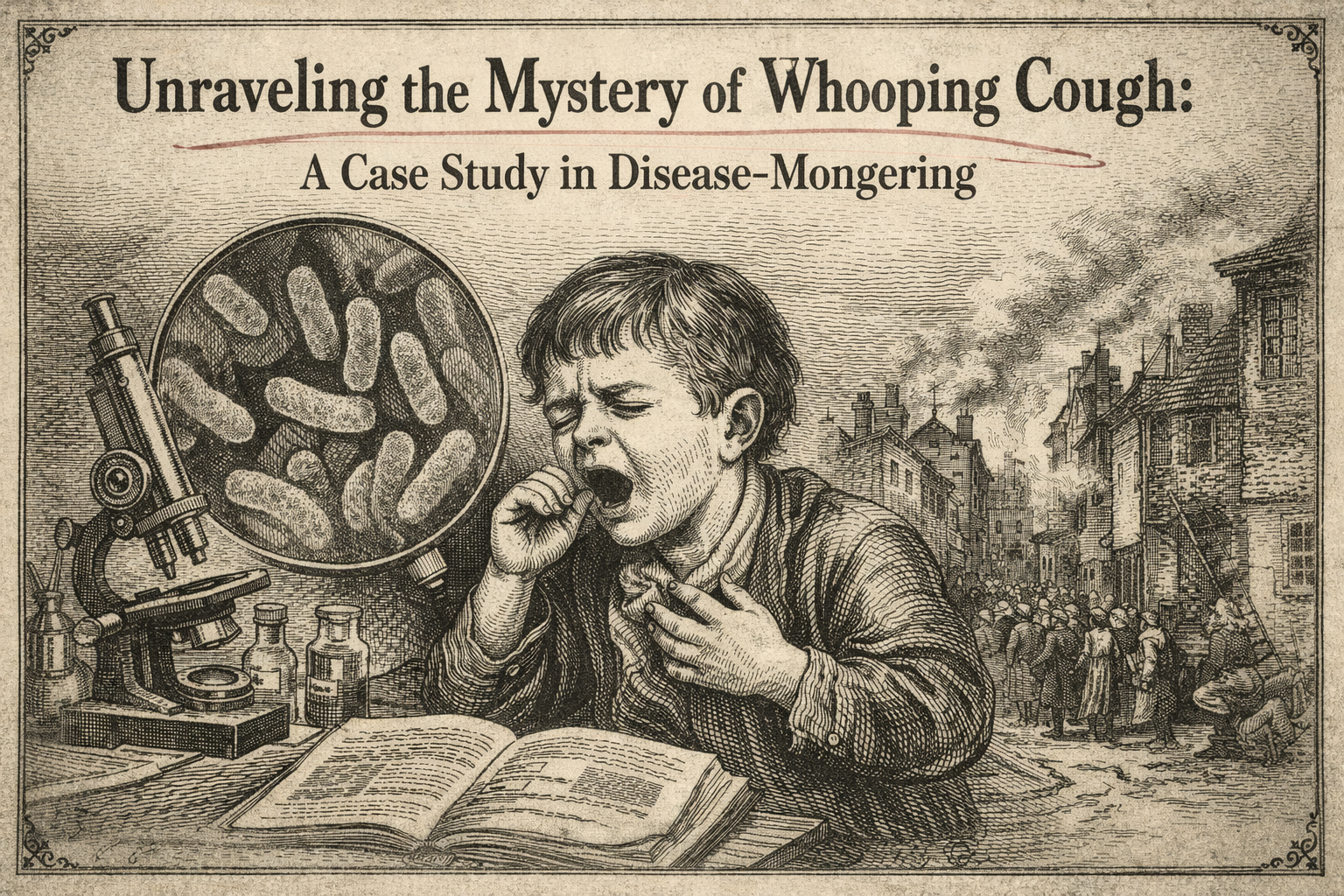
Introduction
Nearly 90% of the total decline in mortality for scarlet fever, diphtheria, whooping cough, and measles between 1860 and 1965 occurred before the introduction of antibiotics and widespread immunization.
Ivan Illich, Medical Nemesis: The Expropriation of Health (1975)
The legitimacy of the concept of vaccination rests upon the three-legged stool of necessity, safety, and effectiveness. If only one of these legs were to crumble, the ideology that vaccination sits on would collapse.
The question of whether vaccines are “safe and effective”—or not!—is hotly and endlessly debated within the health freedom movement. The same battle also rages between health freedom advocates and the Western medical establishment’s “health experts.”
Lost in most conversations about this controversial topic is any consideration of that third leg of the stool: necessity. But if a disease itself does not exist—at least not in the way it has been portrayed—then the imperative to inoculate against it is, at best, no more than tilting at windmills.
In 2024, as part of Health Freedom Defense Fund’s ongoing series on the childhood vaccination schedule recommended by the US Centers for Disease Control and Prevention (CDC), we brought to light the many problems associated with the DTaP vaccine. DTaP is marketed as a means of providing immunity against pertussis (aka whooping cough). In that same article, we hinted at some of the mischaracterizations of pertussis.
In light of the recent spate of emotionally charged media scare tactics about “nationwide surges” and “record cases” of whooping cough, it’s time we take a closer look at the disease itself.
Whooping cough may not fit within the simplistic medical dogma of monocausalism and it may undermine the doctrine of specific etiology, but it nonetheless deserves an in-depth assessment. The story of its history leads us to ask a few questions:
- “Has a specific disease with a specific cause actually been proven to exist?”
- “Is it possible there are multiple explanations for the signature features of this illness?”
- “Is this condition really as dangerous as the medical industry claims?”
What’s In a Name?
Through the years, the “whooping cough” has had many names, all of them reflecting its distinctive “whooping” sound made when the sick person is inhaling after having had a coughing fit of long duration. During the medieval period, the disease was known by other names, such as “the kink” (a violent fit of coughing attended with suspension of breathing) or “kind-hoest” (child’s cough).
Historical records of whooping cough from the early-modern era (1500–1880) are murky.
In the late-17th century the “100 days cough” was given a scientific name, pertussis (Latin for “intensive cough”) by English physician Thomas Sydenham. He asserted that it was necessary for all diseases to be classified and “reduced to certain and specific species.” In Sydenham’s eyes, classification would allow specific medications to be identified to treat distinct ailments.
The incidence and significance of this disease, considered new to Europe until the 18th century, seemed limited.
In 1813, Glasgow physician Robert Watt wrote:
In the English language [I] hardly found a separate work on the subject, nor were the productions of other countries more numerous or respectable than our own.
In 1822, American physician Benjamin Waterhouse remarked:
It is strange, terrible and destructive as this disorder is, that we have no description of it in any book prior to Dr. Thomas Willis.
And in 1894, Charles Creighton, author of an extensive epidemiological study, “A History of Epidemics in Britain,” observed:
It is singular that a malady so distinctively marked as whooping-cough should figure so little in the records of the disease from former times.
Paris in 1578
Let’s go back to the “former times” mentioned by Creighton.
A major epidemic in Paris in 1578 was the first documented outbreak of whooping cough. It was described in detail by French physician Guillaume de Baillou, aka Ballonius (1538–1616), who noted that the severe coughing fits it brought on were mainly in children aged 4–10 years. The violent and dry cough often ended in vomiting, and the disease had a high mortality rate.
Ballonius stated:
The lung is so irritated that in the effort it makes to get rid of that which affects it, it can inhale and exhale only with difficulty. . . . The patient swells up and[,] nearly suffocated, feels as though his breath was stopped in the middle of his throat. . . . Some believe that this name [quinta] was made-up because of the sound of the patient in coughing. The torment of the cough is sometimes suspended for 4–5 hours[,] after which the paroxysm returns, which is often so violent that it causes blood to issue from the nose and mouth and very frequently . . . causes vomiting.
The alleged bacterial cause of these coughing fits wasn’t identified until much later. Furthermore, only retrospectively was this respiratory illness considered distinct and contagious.
When Guillaume de Baillou described the Paris outbreaks in 1578, he didn’t refer to a “whooping cough.” He merely called it a “severe” cough. Older names for it included, as mentioned above, “the kink” (a Scottish word) and “kind-hoest” (a Teutonic term). The name “pertussis” first appeared 100 years later—around 1679 in England.
None of the literature mentioned the wretched living conditions in the Paris of 1578—conditions that quite likely created the perfect breeding ground for a direct assault on the respiratory system.
A snapshot of everyday life for most Parisians in 16th-and-17th-century Paris reveals a metropolis that was crowded, unsanitary, foul-smelling, and sharply divided by class. Streets were narrow and muddy, sanitation was nearly nonexistent. Smoke from wood and coal fires along with the stench and airborne toxins released from human and animal waste filled overcrowded dwellings. Windows were small and rarely opened in winter.
Water was non-potable due to Paris’ primary water source, the Seine River, being contaminated by a combination of tightly packed living quarters, animal waste, industrial pollution, and the close proximity of cemeteries.
Diets for the downtrodden consisted of black bread, vegetable soup, and occasional meat. These foodstuffs were often spoiled and toxic from lack of refrigeration. Worse, late-16th century Paris was marked by recurrent food shortages. Starving people resorted to eating rats, dogs, zoo animals, and military horses. Accounts emerged of cannibalism and of bread being laced with human bone fragments, as chronicled by Pierre de L’Estoile.
Scurvy and other vitamin deficiencies were common. Disease was a constant threat. Rampant cholera, smallpox, typhus, and dysentery caused high mortality, especially among the poor.
Poisons and pestilence were not unique to Paris, of course. They plagued all of Europe throughout the 16th, 17th, 18th, and 19th centuries.
These morbid descriptions aren’t intended to make our readers nauseous. They are meant to highlight the harsh living conditions faced by the vast majority of people in that era and to emphasize how those conditions would have almost certainly caused chronic coughing that led to infectious disease outbreaks as well as countless non-infectious maladies. Given such a noxious environment, finding a single healthy person in city slums would have been next to impossible.
The Birth of the Bordetella Pertussis Bacterium Story
When illness is blamed on bacteria, so-called ‘viruses’ and genes, not only are enormous profits generated for the pharmaceutical industry selling their antibiotics, antivirals, vaccines and the myriad of other related drugs, but it also protects the other hand of the same industry that sells herbicides, pesticides, chemical fertilizers, preservatives, etc. . . . as it obscures one of the fundamental causes of illness . . . our nutrient-deficient and poison-laden foods.
Dr. T. C. Fry, Founder, Life Science Institute
The story of the identification of a specific organism deemed responsible for the serious respiratory affliction commonly known as whooping cough dates back to 1906, when two Belgian bacteriologists, Jules Bordet and Octave Gengou, allegedly isolated the pertussis bacterium.
Their discovery is now accepted in virtually all medical and scientific literature as incontrovertible proof that there is a bacterial cause for this illness. However, multiple problems exist with this claim.
Bordet and Gengou invented a special medium that they used to isolate and identify pathogens, believing their process would create the conditions necessary to isolate the alleged microbe they suspected was responsible for the chronic coughing condition.
The medium itself was made from a melted fluid consisting of a glycerin extract of potato, agar, and salt solution, to which an equal volume of defibrinated rabbit blood or human blood was added.
Bordet used expectorate from his own son, who had just contracted a serious cough. By adding the saliva to the medium, he claimed to have successfully “isolated” what would be named, in his honor, the bordetella bacterium. This “discovery” was published in the Annales de l’Institut Pasteur in 1906.
It should be noted that by this time vested interests in the medical and scientific community were allied with powerful financial forces to influence the public and consolidate the hypothesis that specific micro-organisms were the cause of specific diseases. Leading the charge in this movement was the Pasteur Institute, where Bordet worked and where he developed a prominent reputation in his field.
This closed loop of creation, validation, and institutional promotion of “one microbe to rule them all” had the added benefit (for those same powerful interests) of covering up the massive social crimes of the turn-of-the-century industrial era. The aforementioned filthy streets filled with sewage, the poor nutrition, the polluted water and air, the squalid living quarters, and the brutish social conditions were sidelined as causal factors for illness in favor of microbes and pathogens.
Putting aside for a moment the questionable manner in which Bordet cooked up the “proof” of an isolated, identifiable agent, we must also ask questions about how diseases are caused. In other words, simply making the claim that one has identified an agent of concern does not demonstrate proof of the certain cause of an illness.
For example, even though non-stop coughing indicates that there is a harmful condition in the respiratory tract, there are numerous factors that could have triggered the coughing, from atmospheric pollutants to treacherous living conditions to the consumption or inhalation of toxic substances to poor nutritional status to any number of other origins of such violent and persistent biological reactions.
Ever since Bordet’s dodgy “original discovery” of the pertussis bacterium, the entrenchment of whooping cough as a unique clinical condition that requires a vaccine has been established as an ironclad fact. All alternative hypotheses and explanations are forbidden within the mainstream medical and scientific establishment.
The 1932 Whooping Cough Research Project
When we look at the actual data, we see that although many people did die from whooping cough in the early part of the 1900s, by the time the vaccine had been introduced the death rate [from the disease] in the United States had declined by more than 90 percent. Using the source that was referenced to make the statement in the Pediatrics paper, we see that the decline in deaths from the peak was approximately 92 percent before the introduction of the DTP vaccine.
Roman Bystrianyk and Suzanne Humphries, MD, co-authors, Dissolving Illusions: Disease Vaccines and the Forgotten History
Another fatal flaw in the common portrayals of whooping cough is the faulty field research that was done in the quest for a whooping cough vaccine.
In 1932, bacteriologists Pearl Kendrick and Grace Eldering launched a whooping cough research project in Grand Rapids, Michigan. To make their enterprise seem viable, Kendrick and Eldering claimed that they had improved the methods used for growing the pertussis bacillus, allowing them to design and direct the first large-scale controlled clinical trial for the pertussis vaccine. At the time, the trial was hailed as one of the greatest field tests in microbe-hunting history.
The field trial ran from 1934 to 1937 and was composed of 5,815 children, making it one of the largest controlled trials of its time. The trial aimed to demonstrate that the new pertussis vaccine the two women had developed would provide substantial protection against whooping cough.
The vaccinated group was made up of “children of acceptable age and history who presented themselves at the city immunization clinics for pertussis vaccination.”
The control group was “selected at random from a list of non-immunized children maintained by the Grand Rapids City Health Department.”
Even though an approximately equal sample of children of the same age comprised both groups, the original field trial design was methodologically flawed. The “vaccinated” experimental group was self-selected, but the unvaccinated control subjects were randomly chosen. In addition to this procedural defect, 1,603 of the observations from the study’s early years—equaling a sizable 28% of the total sample—were not included in the final analysis.
Along with these operational deficiencies was the largely overlooked fact that the study was conducted during the height of the Great Depression, an era of extreme deprivation in which daily life consisted of grinding poverty, food scarcity, substandard housing, and extraordinary social stressors. As Grace Elder noted, “[W]e learned about pertussis and the Depression at the same time.”
In the summer of 1936, America’s then-premier epidemiologist, Wade Hampton Frost, a professor of epidemiology at Johns Hopkins University, was tasked with reviewing the Kendrick-Elder study. He identified four major problems, which he attributed to the long, slow build-up of the trial, during which time the study population overall was heterogeneous. To Frost, the heterogeneity meant that:
- In the early years of the trial, follow-up of control children was either inadequate or the records were incomplete.
- Recruitment to the trial varied over the life of the study, as did the frequency of nursing visits to look for whooping cough.
- The possibility of unknown differences between experimental and control groups existed because of differences in the way they had been recruited.
- There was a question as to whether the rates of other communicable diseases were also lower in the experimental group, as might be expected, if the vaccinated children were from a higher socioeconomic group than were children in the control groups.
Nevertheless, the field trials were deemed a success, and Michigan began distributing the pertussis vaccines in 1940.
It must be mentioned that Kendrick and Elder’s admission of the crushing social conditions of the day—which they chose to ignore for study purposes—was vital to the success of the Grand Rapids project. Indeed, this tendency to overlook obvious factors that could skew a study is a regular feature in many, if not all, disease-mongering medical productions.
As we’ll see, another staple in the Big Pharma playbook was used to amplify the whooping cough mythology: inventing cases where none exist.
The Whooping Cough Epidemic That Wasn’t
Almost everything about the clinical presentation of pertussis, especially early pertussis, is not very specific.
Dr. Kathryn Kirkland, infectious disease specialist at Dartmouth College
In 2007, The New York Times published an article that, wittingly or not, exposed how health scares are routinely grounded in false pretenses. The story centered around a supposed whooping cough epidemic in New Hampshire that turned out to be another cry of wolf.
In her article, “Faith in Quick Test Leads to Epidemic That Wasn’t,” Gina Kolata chronicled how nearly 1,000 health care workers at the Dartmouth-Hitchcock Medical Center in Lebanon, New Hampshire, were given preliminary PCR tests, after which some of them were told they appeared to have pertussis.
Here are the specifics: As soon as the first suspected cases of this illness emerged, the hospital administered PCR tests to the workers. When some of the results confirmed the initial diagnosis of pertussis, the Dartmouth-Hitchcock doctors believed the confirmation. From there, they started testing fellow staffers, including those who did not have any whooping cough symptoms or who had only a mild cough or a runny nose but who worked with high-risk patients—infants, for example.
Next thing you know, 134 suspected cases emerged. At that point, 1,445 health care workers were placed on antibiotics. Then, in a matter of days, 4,524 health care workers at Dartmouth-Hitchcock (72 percent of all the health care workers there) received the pertussis vaccination.
Eight months later, the hospital’s staff was stunned to receive an email from administration informing them that the entire scare had been a false alarm.
According to the Times reporter:
Not a single case of whooping cough was confirmed with the definitive test, growing the bacterium, Bordetella pertussis, in the laboratory. Instead, it appears the health care workers probably were afflicted with ordinary respiratory diseases like the common cold.
Asked to comment on the misleading whooping cough scare, Johns Hopkins epidemiologist Dr. Trish M. Perl noted that pseudo-epidemics happen all the time. She cited a similar whooping cough scare at Children’s Hospital in Boston the previous fall, where 36 adults and two children were involved and where definitive tests did not find pertussis.
Dr. Perl told the Times, “[W]hat happened at Dartmouth is going to become more common” as quick results from diagnosing diseases like whooping cough become more routine in the medical industry.
The story is relevant today—not only because it highlights the problems with the PCR process and the medical industry’s quick-trigger response in declaring health emergencies but also because it reveals how hastily doctors are willing to dump many respiratory conditions into the whooping cough category even if the symptoms don’t support that evaluation.
CDC Changes the Whooping Cough Case Definition in 2020
It’s time for the CDC to be truthful with health professionals and all Americans, and to stop denying that it takes corporate money.
Gary Ruskin, Founder and Co-director of U.S. Right to Know
As we fast forward to the present, we notice that the problem of imaginary whooping cough cases and the media frenzy surrounding them has only worsened.
Stories abound:
- There’s reportedly a post-pandemic surge in whooping cough cases across the country.
- Doctors are sounding the alarm as numbers for this disease escalate beyond what they were pre-pandemic.
- Whooping cough cases are on the rise across Arkansas.
- Pertussis cases in South Dakota have purportedly risen.
- Whooping cough cases are soaring as vaccination rates drop.
And on and on it goes.
These reports are often accompanied by emotionally charged tales or graphic images of infants experiencing coughing fits. Notably absent are any explanations or context for these “surges”—such as the “incidental” detail that the case definition for pertussis was radically changed six years ago.
Yes, it’s true. In 2020, the Council of State and Territorial Epidemiologists (CSTE), with input from the CDC, modified the national surveillance case definition for pertussis, which resulted in changes in how cases are counted.
The main change was classifying all PCR-positive cases as confirmed, regardless of a cough’s duration. Previously, a cough of at least 14 days was generally required for most cases to be considered confirmed or probable.
Key changes to the 2020 case definition include:
- Age-specific criteria were removed.
- Confirmed cases were limited to those with laboratory confirmation via PCR or culture.
- PCR-positive cases were classified as confirmed for anyone with an acute cough illness of any duration, reflecting increased confidence in the reliability of PCR testing. [Emphasis added.]
As witnessed during the 2007 false epidemic in New Hampshire, this widening of the criteria would inevitably (and intentionally?) lead to substantially increasing the numbers of whooping cough cases. It’s important to remember that not a single one of those individuals who tested positive at the Dartmouth incident actually had whooping cough.
Obviously, this change has increased the sensitivity of the case definition and has led to more reported cases, because it captures milder illnesses that previously would not have met the strict cough duration criteria. An analysis estimated that the CDC’s change in the way it defines and counts pertussis cases has led to a 10%–25% increase in case counts.
What? The CDC changes definitions and accounting methods so as to blow up an affliction into something it’s not?
Sound familiar?
Conclusion
Chickenpox, measles, whooping cough, diphtheria are not diseases of childhood. They are disorders of ignorance and mismanagement. They are not diseases at all. They are acute illnesses and therefore reactions, curative in intent against existing disease. If children were brought up sensibly, they would never occur.
Dr. Ulric Williams
Calling whooping cough a unique clinical condition is dubious at best.
This is not to downplay the existence of symptoms or to deny the potential severity of the condition. On the contrary, it is to ask the question in full, “What causes whooping cough?”
Retrospectives laden with implied assumptions and gaping omissions have been used to backfill the story of whooping cough in order to create the desired narrative. It’s a way to manufacture and distort a history where no such history actually exists. This retroactive framing then becomes the accepted truth through ideologically driven institutional narratives.
Due to the persistent research and confirmation bias of the medical establishment, the question of what causes whooping cough remains unanswered. What’s tragically missing from the doctrinaire assertion that this condition is caused by a specific bacterium is an entire constellation of other potential factors.
It is this diagnostic sleight-of-hand which prevents us from identifying the full spectrum of possibilities responsible for this serious respiratory problem. Thus, we are thwarted from reducing or eliminating this affliction altogether.