On March 18, 2026, a subtle but important administrative change was proposed that may help identify, support, treat, and study injuries from Covid-19 injections. This seemingly minor suggestion emerged from the Centers for Disease Control (CDC), specifically the National Center for Health Statistics (NCHS) ICD-10 Coordination and Maintenance Committee Meeting, where upcoming changes to medical coding in the United States are regularly discussed by members. React 19, a non-profit organization, proposed changes to include a specific ICD-10 code for adverse events from Covid-19 injections, to which the NCHS responded positively with a proposed new code.
ICD-10 stands for “international classification of diseases,” and this simple code designation, used in electronic medical records and insurance claims, is how the American (and much of the international) medical system communicates about the diagnosis, treatment, and associated reimbursements and payments for a wide range of diseases and conditions. Changes to ICD-10 codes may seem mundane, but such alterations can have a significant impact on health care decisions and even our knowledge about what is happening to our health individually, and on a societal level.
Using a code for a specific condition opens the door for potential reimbursement from public or private insurance schemes, for a treatment algorithm or protocol to be followed, and for research to be done on the condition at a population level. The inverse is also true, as a lack of an appropriate, specific, and easy to use ICD-10 code can hide the cause of injuries or deaths, making research extremely difficult on the topic, and keep health care workers from identifying conditions for which there is no clear code and therefore no reimbursement for their institution or practice.
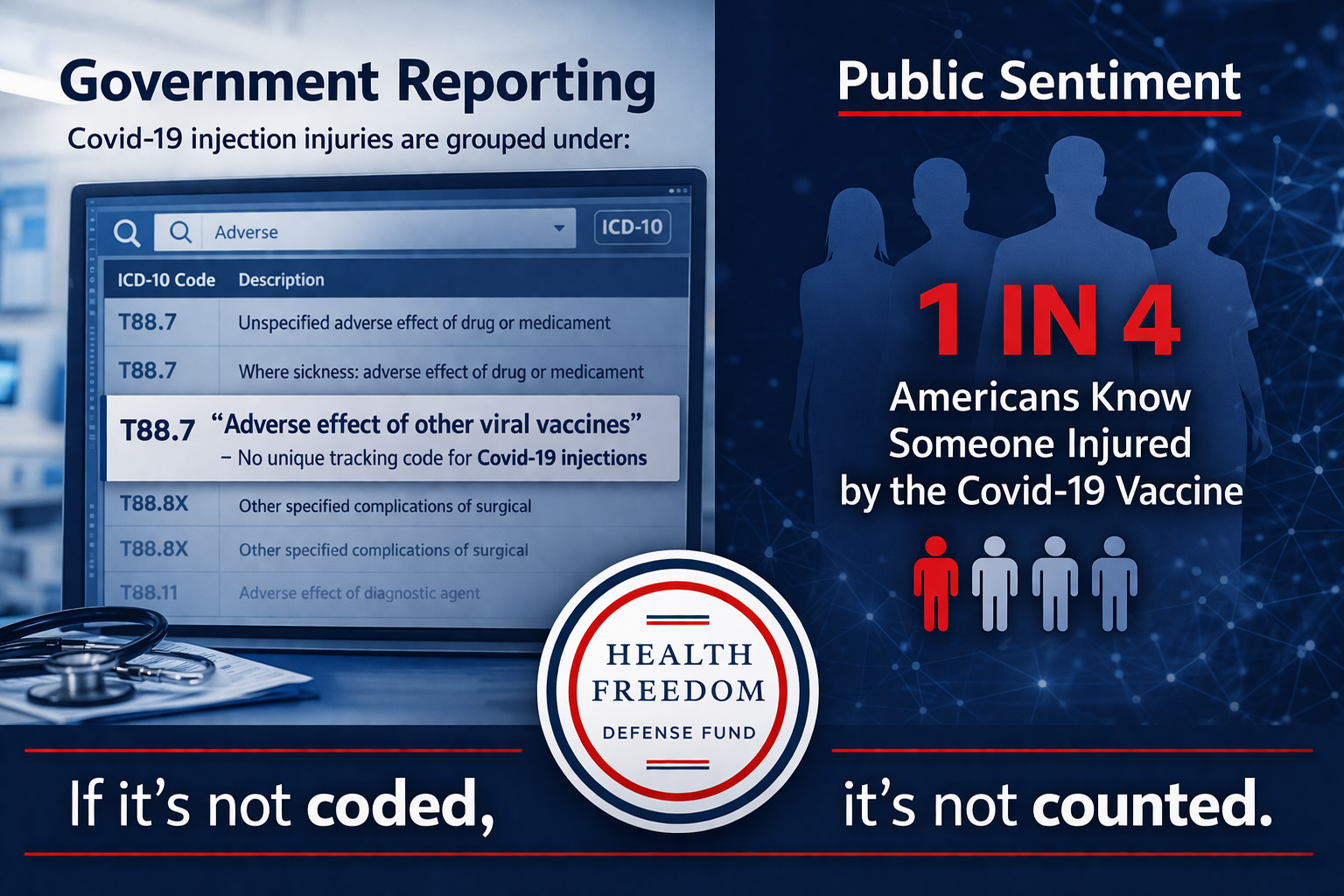
To date, there has been no code for physicians, nurses, medical coders, and medical billers to use to identify injuries from Covid-19 vaccines specifically, despite the majority of the country having taken these products within a few short years. Such injuries, if reported, are lumped in with a catch-all category of all other “[a]dverse effect of other viral vaccines ” in the current ICD-10 system. This requires detailed elaboration and documentation, and makes reimbursement for care cumbersome and difficult, and retrospective, reliable research nearly impossible in the U.S.[1]
This is shocking, given that injury from this unique category of injections—those developed in a rushed fashion during the aptly-named Operation Warp Speed in 2020—is an area of extreme public interest and concern, unprecedented in recent medical history. In multiple rigorous polls, this has been shown to be true [link to HFDF and Brownstone Institute polling here, see backing poll documents]. Just under 25% of adult Americans state that they know someone they believe has been injured by a Covid-19 vaccine, and 10.9% of those same adults polled across party lines believe they themselves were injured. That translates to tens of millions of potentially injured people, whose claims have been systematically ignored through obvious ICD-10 coding deficiencies.
The fact that these injections were rolled out to hundreds of millions under Emergency Use Authorization, illegal employer mandates, and various coercive measures, makes this lack of a distinct code for injury from this unique product even more stunning. This was a unique situation by any historical public health standard, and therefore requires rigorous scrutiny of its impacts. Injuries sustained from these unique mRNA injections—developed outside the already-flawed processes for biologics and vaccines in normal scenarios, should be and must be clearly delineated in the medical coding system for the reasons stated above.
Health Freedom Defense Fund (HFDF) supports the proposed move by the National Center for Health Statistics team at the ICD-10 Coordination and Maintenance Committee Meeting on March 17th and 18th, 2026, to institute a unique code for adverse events from Covid-19 injections. This would go far in disentangling the data for better research, supportive care, and recognition for those who have been injured or who have even died as the result of taking these products. In the words of the CDC’s own NCHS, this will “enable clinicians, researchers, and public health professionals to identify, track, and study these cases.”
Absurdly, since 2015 there is an ICD-10 code for refusing vaccines, which allows physicians or nurses to be reimbursed for spending time pressuring patients to take vaccines. This makes being “under-immunized” a disease in an administrative sense, essentially pathologizing your own personal medical choices. And yet, the epidemic of actual physical injury from a unique, rushed class of mRNA products, all under remarkable government coercion and social pressure, does not rise to that same level of concern in the United States of America. This must change.
A Call to Action for HFDF Readers and Supporters!
HFDF supports the creation of a unique ICD-10 code for adverse events from Covid-19 injections. We call on the public to make their voices heard on this matter and support this initiative, spearheaded by React 19 (their social media post on the matter is here), and now taken up by the NCHS.
Please send clear, concise comments on why this is important to you to nchsicd10cm@cdc.gov
Some important concepts to keep in mind when drafting a comment:
- There is not a current ICD-10 code specifically for Covid-19 vaccine injuries or adverse events despite the largest public campaign in American history to pressure citizens to inject these products and despite high rates of reported injury in polls. Current coding is too vague and complicated.
- Pending proposals to provide a unique ICD-10 code would help facilitate epidemiological research and would allow an easier path for reimbursement to health care providers who support those with injuries or side effects.
- The value of the National Center for Health Statistics would be greatly improved by having more relevant and tailored underlying ICD-10 codes for population-level research and timely provision and reimbursement of care.
- The deadline for public comment is May 15, 2026.
- Any changes on this issue, if approved, would go into effect in April of 2027.
Please consult the document at the following link for meeting details from March 17 and 18th. See page 16 of the file.
https://www.cdc.gov/nchs/data/icd/topic-packet-March-2026.pdf
[1] Note: The World Health Organization does have an ICD-10 code within their system for unspecific “effects” from the Covid-19 vaccines, but, due to technicalities regarding the sub-category, that code is not usable in the American health system.