
Visit our Re-post guidelines
The American Academy of Pediatrics (AAP) has billed itself as a trusted resource for many parents, schools, local health boards, and even state and federal health authorities. By taking advantage of non-profit laws that require minimal disclosure of industry financial support, and by posing as a scientific, deliberative “academy” rather than the industry trade group that it really is, AAP has proven an incredibly useful avenue for pharmaceutical companies, medical device makers, and baby food/formula makers to influence medical policy through AAP’s “advocacy and education” efforts. Unsurprisingly, these efforts always seem to overlap with the industry’s preferred priorities—coerced vaccination without exemptions, medicalization of almost every malady or discomfort, and pathetic obedience to the most draconian school lockdown measures during the covid-19 debacle, including school closures, canceled sports, forced masking of small children, and apathy regarding the epidemic of learning loss, loneliness and emotional distress that resulted.
In fact, AAP is a charitable organization in terms of its founding legal documentation, but an industry trade group in practice. Millions of corporate dollars flow annually into its coffers, with little detail or reporting on where that money ends up, which doctors’ salaries those millions pay for, or what promises are made for the “corporate partnerships” those dollars establish. It is an “academy” only in name, as it represents its corporate partners, donors, and does not engage in scholarly debate on any substantial level. Its increasing relevance today, as many states defer to its guidelines, creates the need for urgent scrutiny of its practices and priorities. The following are AAP’s most urgent ethical problems as a 501(c)(3), tax-exempt organization:
Professional Benefit Over Public Interest
AAP’s policy positions are shaped by their professional priorities rather than open scientific debate and inquiry—let alone on the most urgent health matters plaguing Americans, namely, the epidemic of chronic disease.AAP policy statements are frequently focused only on vaccination or infectious disease, despite its low relative danger, and presented as settled science even when underlying evidence is contested or evolving. The organization also frequently opines on legal, policy, and educational issues beyond its founding purview as a medical education group. AAP has limited known internal mechanisms for structured adversarial review, which is a core feature of genuine academic institutions. Policy statements on their website, or in the “peer-reviewed” in-house journal Pediatrics, are produced by committees and editors with aligned assumptions rather than true scholarly disagreement. The top 24 executives at AAP reward themselves handsomely, with a total of $8.1m in salary and other payments in 2022 alone. The CEO received more than $800,000 in pay that year according to the company’s tax filings. This is not consistent with the public interest, nor is it on par with large non-profits’ executive’s salary levels.
Corporate Obedience
AAP benefits greatly from millions in multi-year corporate funding “partnerships”—a carefully used term to make clear that these are actually corporate fees for services, rather than traditional donations (a common trend in corporate financing of non-profits). Under the Sunshine Act[1], pharmaceutical companies are supposed to report all support to physicians. However, companies that move “unrestricted” money through a non-profit, for example to subsidize the salaries of physicians on AAP’s payroll, easily circumvent that requirement.
Nevertheless, we can make an estimate in terms of how much influence pharmaceutical dollars might be wielding at AAP. In a typical year like 2025, AAP has reported $124 million in assets, but has $101 million tied up in investments, and many grants and donations unavailable for use immediately[2]. So even a few million dollars from corporations per year represent a large percentage of the flexible, unrestricted funds that AAP uses to operate, pay its generous salaries, and pay its $4.5 million annual office lease costs. This gives industry tremendous leverage over the organization.
AAP, of course, has a long history of receiving funding from pharmaceutical companies, health insurance companies, and medical device manufacturers, and junk food companies like Coca Cola (a partnership that was canceled for being too shameful even for their members). This dynamic creates structural incentives that clearly shape AAP’s priorities over the years. Funding from these partners would not flow if there were not an alignment on research priorities, educational materials, and advocacy emphasis. AAP itself admits:
“A partnership does not imply endorsement of an organization’s policies, products, or services and only begins after carefully reviewing factors such as corporate citizenship, shared values, and policy alignment” [emphasis ours].
So corporations don’t need to pressure AAP, they are already “aligned” by the time the first annual donation is accepted. With many states now embracing AAP hard-line vaccination guidelines as often as CDC recommendations, the stakes for their advocacy and priorities are even higher. The outline of this advocacy is formulated at the company’s annual “Corporate Summit” in Itasca, IL each year.
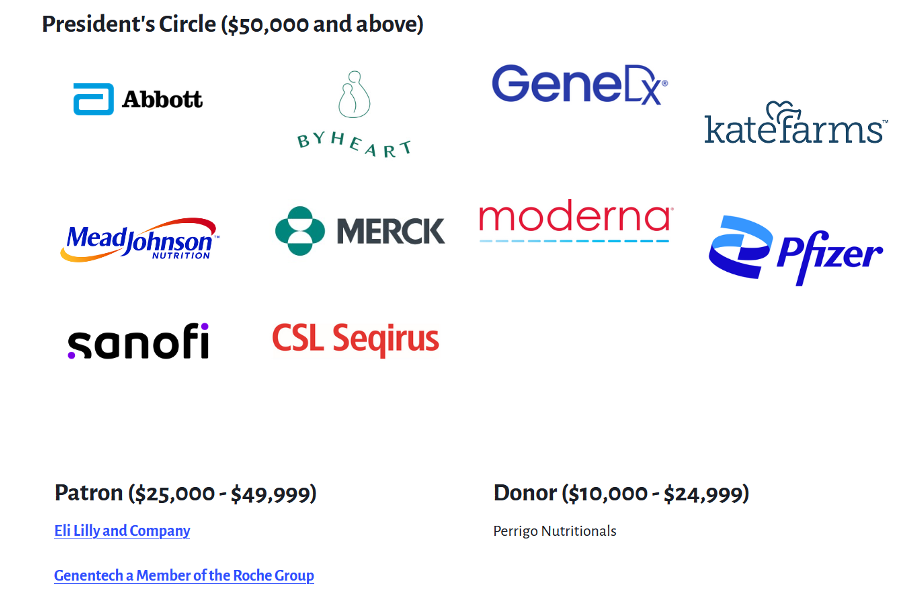
In sum, AAP’s lobbying and regulatory activities resemble a trade association in all but name. AAP engages extensively in lobbying at state and federal levels. While lobbying can be consistent with charitable status to a certain degree, the scope and consistency of advocacy on reimbursement, scope of practice, and regulatory protection align more with AAP’s continued financial survival and the professional self-interest of its “partners”, than charitable relief or education.
AAP Creates and Sells Slanted, “Educational” Advocacy and Guidelines Materials to Fund Its Operations
Dubious “educational” products[3] also function as revenue streams for AAP. In the last 5 years, this guidance included a litany of useless recommendations—plexiglass installed throughout school buildings, unscientific social distancing, and limiting “student interaction”. AAP was immediately on board with CDC’s recommendations for strict masking and constant testing of students, with many local governments and schools citing AAP in their mitigation plans, which when implemented, created an environment where each child was made to feel more like a vector of disease than a human being.[4]
When they are not cheer-leading for unscientific excesses of federal “pandemic response” recommendations, the AAP sells its continuing medical education courses, certification products, publications, and conferences as major ongoing sources of income. These products, without exception, align with industry-supported clinical practices. This arrangement resembles a professional services corporation more than a charitable educational institution oriented primarily (as required by non-profit law) toward public benefit.
Branding and Reputation Substitutes for Transparency and Debate at This “Academy”
AAP recommendations are often enforced, considered, or adopted by schools, courts, and even government agencies, based on institutional authority rather than open scientific scrutiny. This reliance on its “good name” and branding success, rather than transparent debate between experts, is characteristic of corporate influence rather than academic or scientific culture.
For AAP, disagreement on the science or children’s health policy is often framed as misinformation rather than engaged with in a substantial way. Instead of addressing internal or external critiques through open scholarly rebuttal, the organization often characterizes dissent as dangerous or unscientific. This approach protects institutional authority and corporate profits of its benefactors. A classical academy by contrast, exists to advance independent scholarship and open intellectual debate.
AAP has thoroughly disgraced itself in terms of respect for the principle of informed consent—in a summer 2025 guideline, the organization listed incredibly draconian and authoritarian demands on schools, local law enforcement, and pediatricians relating to vaccines.[5] At this point, it is very clear that AAP primarily functions as a professional trade association that represents the economic and regulatory interests of whatever pediatricians are AAP members.
AAP membership itself is tied to professional status rather than scholarly contribution, corporate influence is opaque and significant, and dissenting viewpoints that challenge the failing institutional framework for health care and public health are notably missing in its publications. HFDF urges its readers to share these concerns with anyone who refers to an AAP guideline document as anything other than a press release from the pharmaceutical industry.
Historical Spotlight: AAP and Thimerosal
Until the current administration, AAP not only worked for its industry partners, but also ran political cover for its federal benefactors like the CDC. One example of AAP’s activism could be seen during the debate over thimerosal’s safety (thimerosal is a mercury-based vaccine preservative).
In 2003, CDC director Coleman admitted plainly in the pages of Pediatrics, AAP’s in-house journal,that “the fact is, no preclinical or clinical studies were ever conducted to specifically examine the safety of thimerosal (ethylmercury) at the doses found when used in multiple infant and childhood vaccines,” which neutralized claims from industry that thimerosal was well-studied and found to be safe. This topic was on the minds of many, as starting in 1999 thimerosal was being removed from most routine childhood vaccines (not including influenza vaccines), with AAP refusing to take a strong stand on the topic one way or another.
By December 2012, one former AAP President still defended the preservative in retrospect, and expressed support in Pediatrics for thimerosal staying in vaccines at the time that “[s]cience clearly documented that we can’t find hazards from thimerosal in vaccines”[6]. He phrased this artfully and cynically, as a defense of providing vaccines for the poor, arguing that the preservative allowed broader access (why the poor can’t have the same drug safety standards as the rich, is a different question).
However, during this entire time, AAP and CDC were secretly in damage control mode on a deeper level. It is now known, thanks to Freedom of Information Act requests, that there was a disturbing internal study at CDC by Verstraeten et al., showing a strong thimerosal link to developmental disorders, hidden since 2000. In fact, AAP members and executives were found to be involved in a June 2000 secret meeting in Atlanta with CDC and private researchers to discuss the Verstraeten study that showed a link between thimerosal and intellectual development, and how to manage the aftermath. Pediatrics and the AAP in 2003 eventually published a very different version of the study (wherein the authors changed the methodology) with much of the side effects statistically obscured from the data set[7].
At that time, it seems, the AAP’s course was set. When it came to a potential thimerosal link with developmental disorders and impaired development, AAP has now defended the use of the preservative in flu vaccines, given to children and pregnant women by the millions, for two decades. Even with congressional pressure and an Institute of Medicine report showing no rigorous evidence of safety, AAP continued to defend the preservative and downplay its damage. Fortunately, HHS Secretary Kennedy has formally announced it will be removed from all vaccines with urgency after an advisory board recommended it in July of 2025.
Why would AAP play this subservient and mendacious role, aside from serving to protect the interests of the corporate sector that subsidizes its existence? One answer is that ongoing federal grants sustained the AAP’s growth over that time. Editor Peter Doshi of the British Medical Journal wrote in his series in 2017 that AAP received over $20 million from CDC from 2009 to 2016, which likely played a role in helping keep AAP on-side during this crisis, managing CDC’s reputational damage and keeping its pharmaceutical contributors happy at the same time.
This pattern continued up through the covid-19 era. AAP was a major advocate for mRNA vaccines before their safety profile was claimed to be acceptable by the FDA and CDC. In late 2021 AAP President Szilagyi was advocating for mRNA vaccines in children even before CDC recommendations, and calling safety data “reassuring” for children. She later testified in front of Congress advocating for millions of dollars to be re-routed to the CDC, and for the CDC’s National Center on Birth Defects and Developmental Disabilities to receive over $200 million in appropriations. The center is now headed by former AAP CEO Karen Remly. When it came to the AAP and the federal government, the revolving door continued to turn until 2025. On December 17, news broke that HHS had terminated several grants, totaling roughly $18-20 million to AAP. Time will tell if this is a permanent rupture with the federal government, or a temporary setback for the organization.
Annex 1.
| 2022 990 IRS Data | |||
| Base Compensation | Other | ||
| Ceo/Executive Vice President | $783,954.00 | $16,206.00 | $800,160.00 |
| Chief Population Health Officer | $462,179.00 | $14,956.00 | $477,135.00 |
| Chief Medical Officer | $422,381.00 | $2,700.00 | $425,081.00 |
| Sr Vp, Hlthy Reslnt Chldrn, Yth, & Fam | $385,151.00 | $16,506.00 | $401,657.00 |
| Chief Product & Services Officer | $380,494.00 | $14,616.00 | $395,110.00 |
| Chief Administrative Officer | $377,507.00 | $21,954.00 | $399,461.00 |
| Sr Vp, Global Child Health & Life Support | $369,157.00 | $20,954.00 | $390,111.00 |
| Sr Vp, Education | $367,724.00 | $23,804.00 | $391,528.00 |
| Chief Financial Officer | $361,811.00 | $19,235.00 | $381,046.00 |
| Sr Vp, Primary Care and Subspecialty Pediatrics | $359,319.00 | $22,934.00 | $382,253.00 |
| Sr Vp, Quality | $358,487.00 | $20,059.00 | $378,546.00 |
| Sr Vp, Information Technology | $305,985.00 | $22,906.00 | $328,891.00 |
| Chief Development Officer | $301,550.00 | $20,802.00 | $322,352.00 |
| Vp, Global Newborn & Child Health | $274,982.00 | $26,341.00 | $301,323.00 |
| Vp, Research | $243,965.00 | $13,121.00 | $257,086.00 |
| Vp, Child & Community Health | $237,508.00 | $11,836.00 | $249,344.00 |
| Sr Dir, Federal & State Advocacy | $232,973.00 | $21,409.00 | $254,382.00 |
| Vp, Publishing | $232,526.00 | $18,224.00 | $250,750.00 |
| Sr Dir, Pediatric Practice and Health Care Delivery | $210,603.00 | $18,344.00 | $228,947.00 |
| Sr Dir, Federal Advocacy | $208,899.00 | $17,049.00 | $225,948.00 |
| Sr Dir, Technology Services & It Governance | $201,109.00 | $17,930.00 | $219,039.00 |
| Vp, Marketing & Sales | $198,755.00 | $19,230.00 | $217,985.00 |
| Vp, Chapter Relations & Member Engagement | $195,763.00 | $10,607.00 | $206,370.00 |
| Sr Dir, Applications Development | $189,656.00 | $18,282.00 | $207,938.00 |
| TOTAL EXECUTIVE PAY | $8,092,443.00 | ||
| TOP 24 Positions |
[1] https://openpaymentsdata.cms.gov/
[2] https://downloads.aap.org/AAP/PDF/AAP%20Financial%20Statements_FY25_Final.pdf (page 28)
[3] https://aap2.silverchair-cdn.com/aap2/content_public/autogen-pdf/cms/7145/7145.pdf
[4] https://www.healio.com/news/pediatrics/20200507/aap-issues-guidance-on-reopening-schools
[5] https://publications.aap.org/pediatrics/article/156/2/e2025072714/202656/Medical-vs-Nonmedical-Immunization-Exemptions-for
[6]Tavernise, S “Vaccine Rule is Said to Hurt Health Efforts” New York Times, December 17, 2012
[7] Methodological overview of the 2003 paper: https://onlinelibrary.wiley.com/doi/pdf/10.1155/2014/247218
See our article – HHS De-funding AAP: Has the American Academy of Pediatrics Become an Arm of the Medical Police State?