When Idaho passed the first true medical freedom law in the country in 2025, prohibiting nearly all medical mandates statewide, it was ignored, minimized, or attacked by the media, not only to avoid drawing national attention, but to downplay its significance and reinforce the narrative that health freedom is fringe or dangerous. The data and basic principles suggest otherwise, a reality now reflected in national polls and legislatures across the country.
The Idaho Medical Freedom Act was not an isolated policy development. It was a catalyst. A lighthouse that illuminated a path forward and established a clear legal standard for challenging and ending medical mandates at the state level.
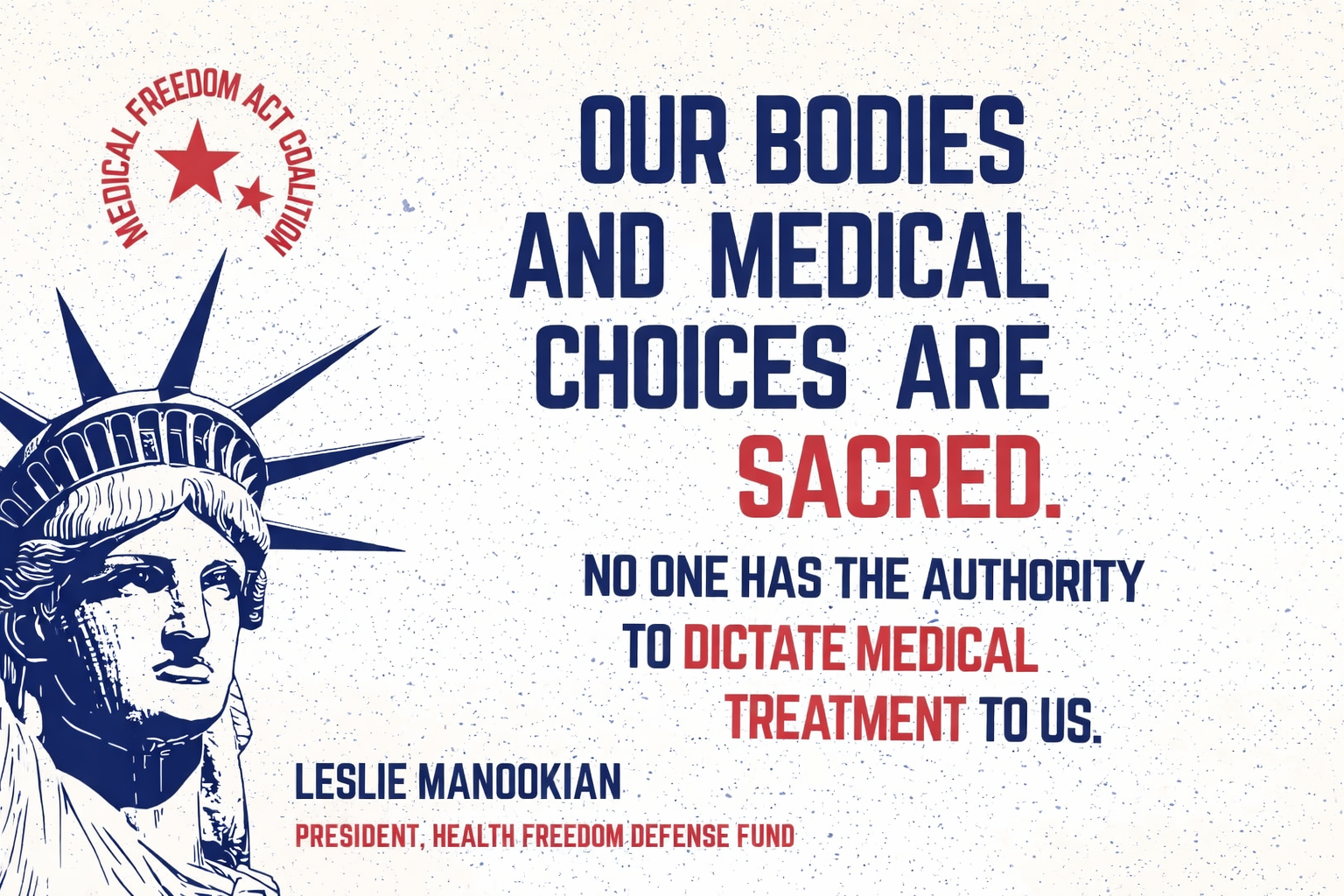
Following Idaho’s Medical Freedom Act passage, Health Freedom Defense Fund (HFDF) developed a model Medical Freedom Act and supporting toolkits for grassroots and legislators to provide a map for other states to follow. To ensure that effort could move effectively within each state’s legislative process, we partnered with Stand for Health Freedom (SHF). From that partnership, the Medical Freedom Act Coalition (MFAC) was formed.
Together, with national partners including Americans for Health Freedom, Autism Action Network, Brownstone Institute, Children’s Health Defense, Citizens’ Council for Health Freedom, Feds for Freedom, Freedom Counsel, Global Wellness Forum, Independent Medical Alliance, Institute for Pure and Applied Knowledge, MAHA Action, MAHA Institute, Moms Across America, We the Patriots USA, and the Weston A. Price Foundation, we are advancing legislation designed to restore medical decision-making to the individual and to end coercive mandates in law.
Leslie Manookian stated in her Reuters interview:
“We breached the dam in Idaho in 2025. And now the mission is to burst the dam open.”
She added:
“In the aftermath of the Covid overreach, medical freedom has become the issue of our time. If we don’t have the power and authority to direct our own medical treatment, we are not free.”
And burst open it has.
In early 2026 alone, Medical Freedom Act–aligned legislation has been introduced or is advancing in more than a dozen states, including Arizona, Oklahoma, New Hampshire, Hawaii, South Carolina, Vermont, Iowa, Kansas, New York, Indiana, Florida, and Idaho. Some of these efforts are moving steadily through the legislative process, while others are encountering resistance or being reshaped along the way. Either way, what began in one state is now taking hold across many.
Arizona’s progress reflects a growing willingness among legislators to engage the issue directly. Idaho’s expansion effort shows that these protections are not only holding, but evolving. In Florida, when a late-stage amendment threatened to undermine parental rights, it was identified and halted through coordinated action, a sign that the medical freedom movement is here to stay and is no longer reactive, but organized.
None of this is unfolding in isolation, and it is not out of step with the public sentiment.
A national poll commissioned by Brownstone Institute and Health Freedom Defense Fund (HFDF) and conducted by Zogby Strategies, offers a clear window into where voters actually stand. Far from the characterization that health freedom is fringe, the results show broad and consistent support for the principles now being advanced in law. Ninety-one percent of those polled support the right to informed consent, eighty-eight percent support the right to refuse medical treatment, and eighty-seven percent recognize medical choice as a fundamental human right which should be codified in law.
That level of super majority consensus is rarely seen in polls regarding any issue—and it reflects how people vote. Nearly two-thirds of voters report they are more likely to support candidates who defend medical rights and challenge mandates, a signal that health freedom will be a winning issue at the polls.
As outlined in The Deceptions of the Press and the Why of the Poll and further examined in Conflicted Polling Agencies Are a Danger to Society, polling has all too often been used less to measure public sentiment than to shape it.
The Zogby poll commissioned by HFDF and Brownstone Institute asked honest, unbiased questions in order to determine the true sentiment of American voters regarding health freedom not to manufacture support for it—and in the process the poll revealed just how much of it is already present.
Americans cherish their individual liberties and this poll proves that unequivocally. It is in that context that the coalition’s message resonates as clearly as it does.
As Leah Wilson, SHF co-founder and Executive Director has said:
“No mandates. For everyone. Without exception.”
It is a statement that reflects not only principle, but the expressed will of a broad majority of Americans.
In 2025, Idaho proved medical freedom could be achieved and thirteen bills in thirteen states show that freedom is a universal issue. We may not win in all these states overnight but we have the momentum and will continue to work to ensure all states protect the right to health freedom.
Which brings the issue back to the simplest of questions.
Who decides what goes into your body?
A government agency?
An employer?
An institution?
Or you?
What began in Idaho has brought that question into legislatures across the country, and voters have already made their position known. Americans understand the principles of informed consent and health freedom—and that is not going to change any time soon.
We are not working to refine mandates—we are working to end them. What began in Idaho is now unfolding across the country.
“No one and no government has the right to mandate medical interventions.”
– Medical Freedom Act Coalition motto