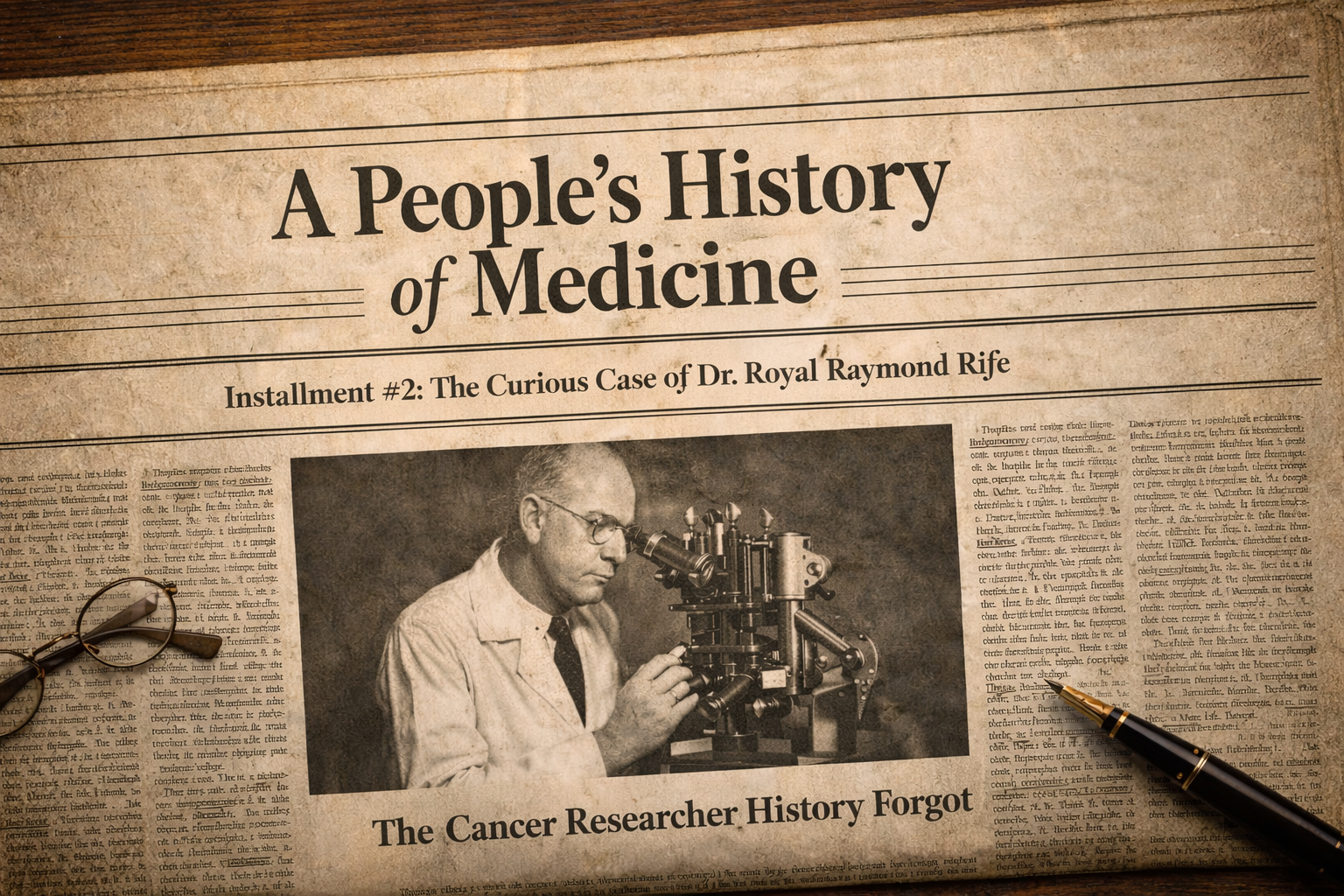
Royal Raymond Rife Jr. was born in Elkhorn, Nebraska, on May 16, 1888. In 1905, after graduating from high school at the age of 17, he entered the John Hopkins University School of Medicine, which was founded in 1893. During his studies there, he developed an interest in bacteriology. He left school before graduating. Later on, he resumed his academic studies at Heidelberg University in Germany. After Rife developed all of the photomicrographs for a so-called Atlas of Parasites that he created for the university, he was recognized with an honorary Doctor of Parasitology degree in 1914.
In 1912, Rife moved to San Diego, California, where he established a research laboratory and began his work as a research pathologist. When Rife built his first microscope in 1920, he was motivated by his belief that in order to cure a disease one must be able to see and identify microorganisms that could possibly be the causal agents of the malady.
Crucial to the trajectory of Rife’s career in medical research was the unusual relationship he formed with multimillionaire Henry Timken, who built his fortune through the Timken Roller Bearing Company.
In 1913, when jobs were scarce, Rife began working as Timken’s personal chauffeur, a role that led to Rife and his wife moving into an apartment above the tycoon’s garage. After the inventive Timken learned of Rife’s engineering prowess, they embarked on a partnership that would extend well beyond driver-and-passenger and apartment owner-and-tenant relationships.
It wasn’t long before Timken recruited Rife to build an engine for his high-performance speedboat named Kitty Hawk the Fifth. This was no ordinary engine. It produced 2,700 horsepower and broke speedboat records by doing an endurance run that covered 100 miles at an average speed of 87 miles per hour. This unprecedented feat, which was accomplished in 1915, demonstrated both the power of the engine and the reliability of Timken’s tapered roller bearings for marine propulsion systems.
Timken’s confidence in and reliance on Rife only grew after Rife solved the problem of malfunctioning roller bearings by designing and building an X-ray machine that checked for hairline fractures in the chrome steel. This invention enabled Timken’s company to discard faulty bearings, which saved millions of dollars—and earned Rife a monthly lifetime payment.
Timken and his partner, Appleton S. Bridges, were so impressed with Dr. Rife that they set up a fund to finance for him a completely equipped laboratory at Point Loma, California. It covered his research program expenses plus the pay of twelve laboratory assistants.
It was in this lab that Rife designed and built magnifying instruments that worked differently than the existing microscopes of his day. In fact, in 1933 Rife designed the most powerful and versatile optical microscope of its time. This Universal Microscope was groundbreaking in the way it was able to use all types of illumination as well as in the way it could be used for all categories of microscopical work.
In contrast to the electron microscopes of the day, Rife’s Universal Microscope did not kill the specimens under observation, for it did not rely on staining to render visibility. Instead, his microscope used various modes of lighting to improve visibility. To enhance the images, Rife employed a device called a Risley counter-rotating prism, which he mounted under the microscope’s stage (the platform that holds the specimen being observed). The prism allowed him to direct a powerful monochromatic beam from his patented lamp, which in turn allowed normally invisible bodies to become visible in a color that was said to be peculiar to their structure or chemical make-up.
This method caused Rife to posit that microscopic organisms might have a range of refraction that could respond to various light environments—and to suggest that organisms could be classified by their index of refraction.
With an appreciation for the genius of Dr. Nikola Tesla and other engineers and inventors, Rife began to focus his energies on the plausible connections between electrical, magnetic, and radio frequencies and the human body.
His work took a turn toward exploring the effects of electromagnetic frequencies on biological systems. Doing this research, he discovered that microbes had a particular frequency to which they were vulnerable, a term he would call the “mortal oscillatory rate.”
Legend has it that in 1934 there was an experiment—supervised by a Special Medical Research Committee, including Dr. Milbank Johnson, and sponsored by the University of Southern California—that involved sixteen terminally ill cancer patients who had been selected from a hospital in San Diego for a clinical trial.
The experiment took place on a ranch owned by a member of the Scripps family, often referred to as a “small Los Angeles clinic” or a “La Jolla ranch.” The patients were brought in and treated for 90 days with Rife’s “Beam Ray” device, which was set to the frequencies recommended by Dr. Rife.
Supporters claimed that 14 of the 16 patients were declared “clinically cured” within 70 days, and the remaining two were cured after 20 more days.
Controversy concerning this trial and Rife’s entire body of work continues to this day. The University of Southern California has stated that no records exist of such an experiment. Not surprisingly, the American Cancer Society and the medical establishment consider Rife’s claims to be implausible and his work to be lacking in scientific rigor.
Proponents of Rife maintain that the results were suppressed by the Morris Fishbein-led American Medical Association (AMA). Fishbein was notorious for attacking any and all medical treatments that did not comport with the burgeoning, profit-driven pharmaceutical industry. He destroyed the careers of any doctors who challenged the autocratic control of the AMA. This is the same Fishbein-led AMA that took millions of dollars from Phillip Morris in exchange for having doctors recommend cigarettes to their patients to “soothe the throat” and “calm the nerves.”
Fishbein was forced to retire from the AMA after a court found him guilty of libel in Hoxsey v. Fishbein (1949). Afterwards, he took a paid position in the tobacco industry.
Rife’s work was caught in the maelstrom of the radical shift in America toward centralized medicine, promulgated by the Carnegie Foundation’s Flexner Report and enforced through institutions like the AMA. Suffice it to say that, under the dictates of this industrial medical paradigm, Rife’s work was constantly under attack.
Doctors who used the Rife machines were being pressured to stop this practice. Their offices were broken into and the machines confiscated.
The tragic aspects of Dr. Rife’s story involved unending court battles and stolen microscopes. Worse, when his laboratory suspiciously went up in flames, all his records and research were consumed by the fire. Then there was the mysterious death by poisoning of Dr. Milbank Johnson, an early supporter of Rife—and the man most responsible for bringing public recognition to Rife.
By 1940, Rife’s lifetime body of work was all but wiped out. He sank into depression and alcoholism. In 1971, Royal Rife died from a combination of Valium and alcohol at the age of 83.
Despite his tragic twilight years, Dr. Royal Raymond Rife’s lifetime legacy lives on. His research and ideas are quietly being reborn today—even within the world of what is regarded as mainstream medicine.
Recently, researchers from Rice University, Texas A&M, and the University of Texas at Austin developed, in collaboration with Portugal, what they believe may be breakthrough cancer therapy. This treatment uses targeted, near-infrared light to activate molecules that destroy tumor cells while sparing healthy tissue—and, importantly, without the use of chemotherapy, toxic drugs, or radiation.
Another treatment, called histotripsy, has been developed at the University of Michigan. It uses focused ultrasound waves to mechanically break apart tumors, and it has recently been approved for treating liver tumors.
Will these treatments be the long-awaited miracles that will cure cancer? That remains to be seen.
To advance and reclaim the work of an authentic medical science that serves the people, it is important to recognize that the current parameters of how diseases are defined are insufficient. It is equally crucial to realize that the obstacles to addressing cancer and a host of other conditions are more economic and political than scientific.
Dr. Royal Raymond Rife’s ideas were a threat to the international pharmaceutical-medical monopoly, and for that reason he was condemned by them.
The story of Dr. Rife and his machine isn’t just a piece of history. It’s also a blueprint for how truth is suppressed and erased whenever it threatens the establishment’s profits and power.
Our recounting of the Dr. Royal Raymond Rife story is a step towards restoring his rightful place as a genuine pioneer of medical science who placed people above profits and power.
A detailed account of Dr. Rife’s life can be found in this five-hour documentary, “Royal Raymond Rife—The Rise and Fall of a Scientific Genius.”
“You can kill the dreamer, but you can’t kill the dream.”
—Martin Luther King Jr.