As we survey the landscape of the medical industry in the 21st century—a sprawling system of allopathic medical schools, highly regimented doctors and nurses, high-cost treatment plans, high-tech diagnostic mechanisms, high-volume, high-cost elective surgeries, labyrinthine billing codes, a limitless menu of pharmaceutical drugs, and much else that comes with what we have been conditioned to think of as “modern medicine”—it is undeniable that this vast medical apparatus has become antithetical to the true art of healing and has strayed far from the needs of the people it should be helping.
The long and tragic record of medical error, diagnostic failures, mistakes in care, pharma corruption, bloated spending, and poor outcomes has been chronicled at length and in great detail and need not be reviewed here. Suffice it to say that it would be quite the challenge for even the most ardent loyalist of this medical network to put a positive spin on the answer to the question, “Is it working?”
And while this Leviathan currently has a stranglehold on the ideological foundations and the healthcare industry, it’s important to remind ourselves that it was not always this way nor need it remain this way.
One of the first steps toward ushering in a more restorative and compassionate medical system is to take back our history and explore the entire range of possibilities that “could have been” had the trajectory of the medical field been allowed to unfold in an organic manner.
As we embark upon this new series of articles, it’s important to state upfront that we are not proselytizing for any individual person or type of treatment nor are we offering medical advice.
These reports are not intended to be lengthy dissertations about the people or ideas we feature. Instead, they are short presentations intended to resurrect forgotten histories, invite discussion about what a return to a people-centered medical system could look like, and pique the curiosity of readers who may want to explore aspects of health and healing that have been deliberately suppressed by the mainstream.
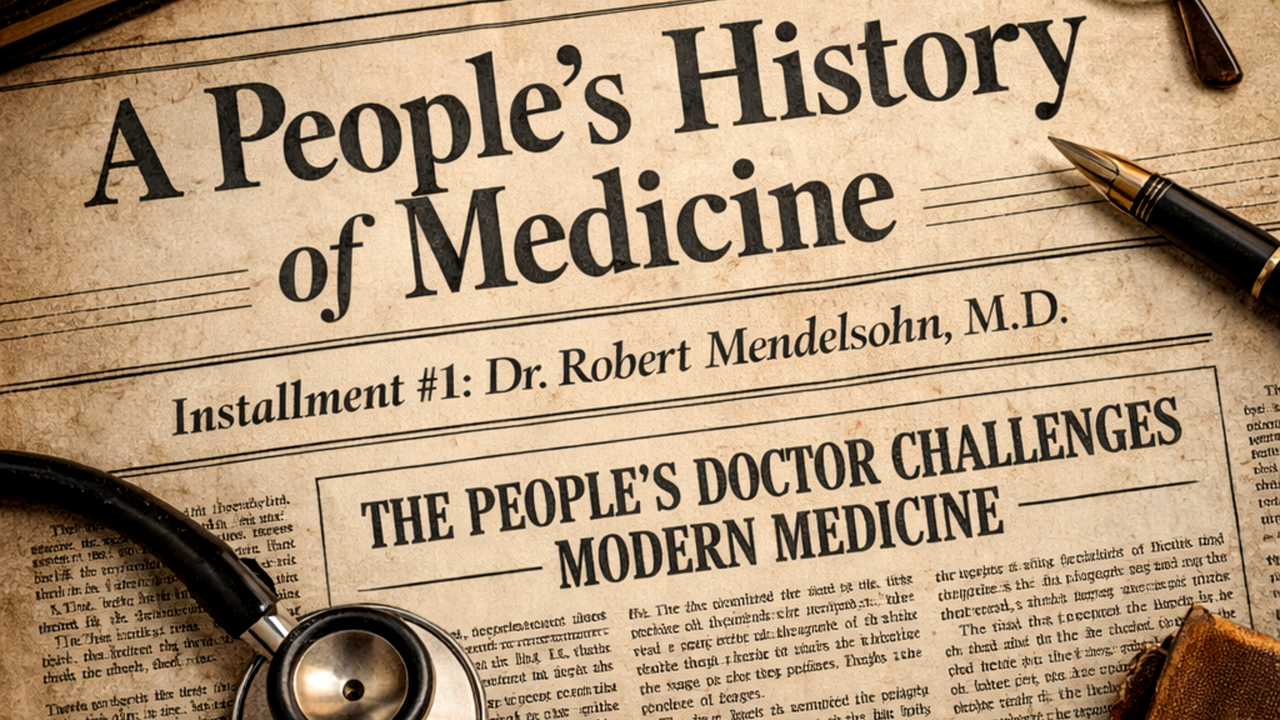
In that spirit, we begin our journey into these forgotten corridors by introducing a legendary medical heretic named Dr. Robert Mendelsohn, M.D.
In his book, Confessions of a Medical Heretic, Dr. Mendelsohn makes the controversial statement, “Medicine is not based on science — it’s based on faith.”
Who is Dr. Robert Mendelsohn? Or, rather, given that he was born in 1926 and passed away in 1988, what was he known for in his life? What were his accomplishments?
Dr. Mendelsohn was an American pediatrician who received his Doctor of Medicine degree from the University of Chicago in 1951. For twelve years he was an instructor at Northwest University Medical College and for the next twelve years was an Associate Professor of Pediatrics and Community Health and Preventive Medicine at the University of Illinois College of Medicine.
He appeared on over 500 television and radio talk shows and authored five books: Confessions of a Medical Heretic; Male Practice: How Doctors Manipulate Women; Dissent in Medicine; But Doctor, About That Shot:The Risks of Immunizations and How to Avoid Them; and How To Raise a Healthy Child In Spite of Your Doctor.
Dr. Mendelsohn had a full-time private pediatric practice in his office in Chicago from 1956 to 1967 and after “retiring” continued to see patients of all ages on a consultancy basis at his home. He was also a longtime supporter of the volunteer breastfeeding support organization, La Leche League International, serving on its Medical Advisory Board and speaking frequently at its conferences.
Dr. Mendelsohn possessed an affable and approachable manner and was known for his humility and his respect for mothers.
Here’s a well-known example of how Dr. Mendelsohn treated others. Each Friday he moderated a well baby clinic at the University of Illinois. Some of the panelists were resident physicians, medical students, and nurses on staff at the clinic. But the panelists who led the discussion were the mothers who had brought their babies to the clinic that afternoon. They were of every ethnicity and all were poor. As you can imagine, putting the moms in charge of the panel—the subjects covered, the advice given, the stories told— was unheard of in the medical field back then, and it remains unheard of today.
One doctor recounts the experience:
We had all, as medical students, been inculcated with the idea that these mothers were inadequate, if not downright incompetent, and in desperate need of our advice. By masterfully interviewing these mothers, Bob taught us how wrong we were. One by one, they revealed a deep understanding of motherhood and of their infants, often using folk wisdom that had been handed down to them. This taught us all humility, a rare trait in physicians, and respect for mothers, even poor ones. It was a powerful lesson.
Dr. Mendelsohn’s custom of treating mothers and, indeed, all patients, with a high degree of respect and dignity earned him the moniker “The People’s Doctor.”
Dr. Mendelsohn was an outspoken critic of hysterectomies, radical mastectomies, and dangerous medications. He was equally critical of public health failures like the 1976 swine flu outbreak and the damage caused to daughters of women who took the drug diethylstilbestrol during pregnancy.
While Dr. Mendelsohn is best known for Confessions of a Medical Heretic—which opens with the stirring declaration, “I do not believe in Modern Medicine. I am a medical heretic. My aim in this book is to persuade you to become a heretic, too”—his life and legacy are memorable for much more than that quote.
For instance, Dr. Mendelsohn encouraged patients to investigate the prescribing information for drugs they were considering taking, and he urged parents to carefully consider the harms versus the benefits of routinely recommended immunizations. In addition, he encouraged patients to learn about and try out lifestyle changes and to take natural approaches to their health care rather than automatically turning to drugs.
He also warned against potentially unnecessary and dangerous surgeries: “Ninety percent of the most common operations [are] at best of little value and at worst quite harmful,” he remarked. And he took note of the rampant male chauvinism within the medical industry, which, he said, “pervades American medicine from the doors of medical school to the slabs of the hospital morgue.”
Midst all of his accomplishments and the accolades he has earned for them, perhaps what Dr. Mendelsohn should be remembered for above all was his high regard for parents and his humble, patient-centered approach to care, which could be summed up by his observation, “Parents and grandparents are wiser than doctors.”
John McKnight, a friend of Mendelsohn for 25 years, had this to say of the good doctor:
A lot of people would call him a dissenter, but I think that misses the point. I think of him as a scientist, a person who understood that what passes for medical science is a belief system much like religion.
To learn more about Dr. Mendelsohn’s insights and ideas, you can visit The People’s Doctor, a website lovingly created by his daughter and her mother and sister.