Visit our Re-post guidelines
In 1995, John Stauber and Sheldon Rampton published Toxic Sludge Is Good for You!: Lies, Damn Lies and the Public Relations Industry, a landmark expose’ that detailed how the corporate public relations (PR) industry manipulates public opinion and shapes government policy. The title itself is a sarcastic reference to a real-world PR campaign that rebranded industrial and municipal sewage sludge as “biosolids” to convince the public and farmers that this toxic stew was a safe and beneficial fertilizer.
Following the Clean Water Act, wastewater plants were confronted with a huge problem: how to handle astronomical and growing disposal costs for millions of tons of contaminated sludge. To tackle this dilemma, the Water Environment Federation, backed by the EPA, launched a campaign based on linguistic jiujitsu, astroturf tactics, and the suppression of dissenting scientists whose research showed that treated sewage sludge was causing illnesses, livestock deaths, and environmental damage. All of this to hoodwink the public into thinking that spreading industrial waste on agricultural land was a “green” method of environmental recycling.
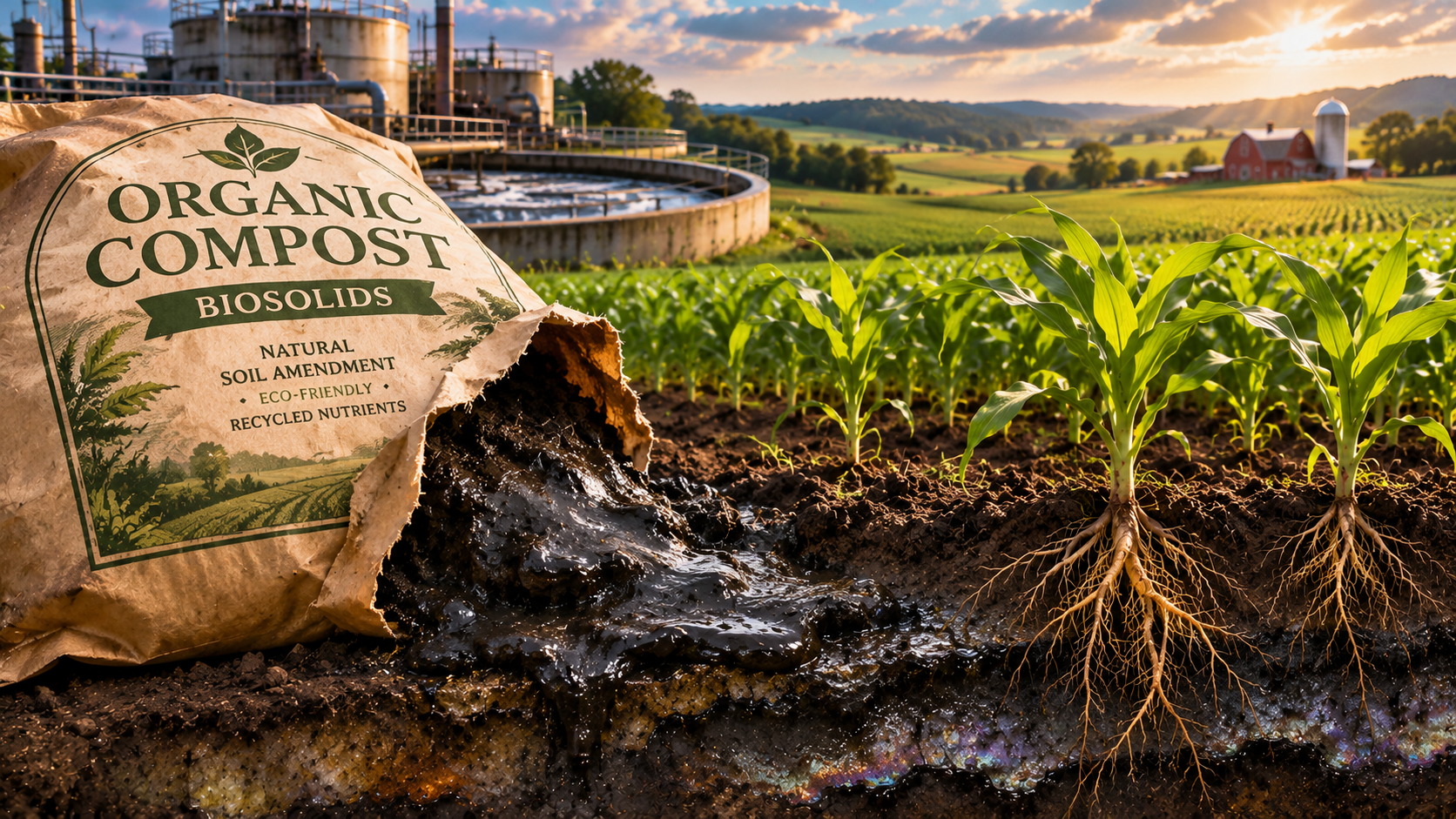
In the book’s namesake Chapter 8, “The Sludge Hits the Fan,” Stauber and Rampton expose how this corporate strategy evolved into a massive PR campaign funded by hundreds of millions in tax dollars. By rebranding municipal human sewage waste into the eco-friendly-sounding term “biosolids,” the PR industry successfully shielded the sewage disposal industry and federal regulators from public scrutiny for over three decades. This insidious corporate program deceived the public into believing that hazardous industrial and municipal waste is an “eco-friendly” consumer product, which crushed community resistance and created a total media blackout on the scam.
Decades after the book’s publication, this deception remains alive and well, as millions of tons of this toxic waste continue to be integrated into consumer products and spread across American farmland under the very same “biosolids” label.
Beneath this underhanded propaganda campaign lies the grim environmental reality of how trillions of gallons of hazardous waste, including toxic industrial byproducts like PFAS, PCBs, dioxins, and chemical pesticides, are being dumped directly on American communities, agricultural soils, and indirectly into our bodies. Through contaminated agricultural crops, deceptively branded community giveaway programs, and “organic compost” sold in stores, these toxic residuals end up in the dirt our children play in and the food we eat, all to protect corporate America’s bottom line.
How this toxic goop is allowed to be passed off to an unwitting public is a lesson not only in the mercenary priorities of corporate America but also puts a fine point on the broader realities of how the US political system works and who it works for. The toxic sludge story isn’t just a tale about a diabolical scheme hatched to poison the public, though it does just that, it’s an object lesson in the standard operating procedure of big business in America and how US regulatory and political officials grease the wheels of some of the filthiest industries on earth.
Corporate Cost Cutting at the Public’s Expense
The story begins in 1972 when the Clean Water Act became federal law, prohibiting US industries from using waterways as their free-for-all corporate sewer systems. This meant the legal disposal of hazardous industrial waste was about to become incredibly expensive leaving textile mills, paper mills, and chemical manufacturing plants scrambling for solutions on how to absolve themselves of the coming financial calamity. The stranglehold tightened with the 1976 Resource Conservation and Recovery Act, which led to aggressive federal oversight of corporate dumping, compounding the problem for the corporate sharks and their bean counters who were used to treating the American townships, watersheds, and local byways as their private dumping grounds.
To dodge the newly required treatment and disposal fees, manufacturing corporations began routing their toxic wastewater directly into local publicly owned treatment works, more commonly known as municipal sewage systems. By dumping these chemicals into the public sewer system, corporations cut their disposal costs and left the municipal utilities, local governments, and taxpayers holding the bag for their concentrated toxic waste. By shifting this nightmare onto cities, corporate polluters successfully privatized their profits while socializing the costs, a classic tactic and the essence of what is now called “public-private partnerships.” Forced to treat this sludge as the hazardous industrial waste it is, local governments faced astronomical disposal costs and the threat of bankruptcy.
The crisis escalated rapidly after the Ocean Dumping Ban Act of 1988, which prohibited cities from dumping their sewage sludge into the ocean. Suddenly, major metropolitan areas were buried under billions of pounds of toxic sludge with nowhere to put it. Incineration ran into strict federal regulations like the Clean Air Act and traditional landfills were rapidly filling up. A large scale and more permanent answer was needed. That solution came in the form of government collusion with corporate polluters to orchestrate a deceptive rebranding campaign. This industrial-grade sewage sludge was given another name, “biosolids,” and marketed as an eco-friendly, organic fertilizer.
The EPA, in league with the waste management industry, stepped in and created the 1993 Biosolids Rule (40 CFR Part 503) which opened up major loopholes, allowing cities to legally spread what would otherwise be considered industrial waste onto American soil. From there, the EPA, working hand in hand with trade associations, partnered with municipal wastewater industries to launch aggressive public relations and marketing campaigns, fobbing this noxious gunk off undercover community “recycling programs.” By rebranding sludge as fertilizer, the toxic reality of this industrial waste was swept under the rug under the guise of sustainable agricultural recycling. By giving it away (or selling it) to communities and farmers, and rewriting the rules to allow land application, the EPA essentially protected both industrial polluters and municipalities from any legal blowback saving both billions of dollars.
Corporate Polluters and Their “Externalities”
The predatory practice of offloading waste at the public’s expense is not new or unique to the “biosolids” boondoggle. If they had to pay the true costs of safely disposing of their waste and fully compensating communities for health damages, most of these large-scale industrial operations would go out of business.
By coining their waste with the polite, clinical term “externality,” corporations conceal the reality of how they turn their garbage into someone else’s problem and effectively remove that cost from the balance sheet. By treating their effluence as an accidental side effect rather than a core feature of their business model, this sanitized corporate language shields companies from public wrath and legal accountability.
Industries such as textile mills, paper mills, and chemical manufacturing plants are some of the primary offenders when it comes to using the biosolid smokescreen to dump their toxic trash across the country. Because these industries consume millions of gallons of water to process materials using heavy chemicals, their wastewater contains high concentrations of persistent pollutants that municipal filters cannot remove. Shifting the destination of these industrial chemicals to agricultural fields might help them avoid bankruptcy, but it leaves the public with a toxic legacy.
Textile mills are notorious for discharging toxic chemicals, especially per- and poly-fluoroalkyl substances (PFAS), known as “forever chemicals,” into municipal wastewater systems. The fabric dyeing, printing and finishing operations required to make clothes colorful, stain-resistant, and water-repellent create a chemical “textile sludge” laced with leftover synthetic dyes, fixing agents, heavy metals, surfactants, and salts. This devil’s brew is incredibly sticky and chemically complex, making it exceptionally difficult to break down. Because textile wastewater undergoes extensive physical-chemical treatment, the volume of generated chemical sludge is massive. Via the “biosolid loophole” this industrial by-product of contaminated wastewater is allowed to be pumped into municipal sewer networks, then undergoes a process which leaves behind a nasty semi-solid sewage sludge—oops, we mean “biosolids.” As the resulting muck contains nitrogen and phosphorus it’s marketed and distributed to farmers as a cheap or free “nutrient-rich agricultural fertilizer!”
The harsh reality of this malignant marketing scam can be seen in the real-world fallout of the abandoned Galey & Lord textile mill in South Carolina. For decades, the mill treated its wastewater in lagoons and distributed the resulting sludge to surrounding farmers as “free fertilizer.” The sludge was heavily contaminated with PFAS, ultimately forcing the state to push for thousands of acres of active farmland to be declared a federal Superfund cleanup site, the first case of its kind where pristine agricultural land was ruined strictly by sludge fertilizer.
Another corporate culprit in the biosolids saga are paper and pulp mills that consume vast amounts of water to break down wood into fibers and treat paper products. To manufacture food packaging, boxes, and glossy paper, mills historically used FDA-approved PFAS formulations. Part and parcel of the treatment of paper products are chlorine bleaching agents that generate dioxins and furans, some of the most toxic synthetic chemicals known to science. In states like Wisconsin and Michigan, paper mills have heavily utilized land-spreading for their paper mill residues. The Crown Vantage paper mill in Michigan dumped its PFAS-containing grease-repellent sludge into local sites for decades. Over time, this mill sludge leached directly into public drinking water supplies, resulting in massive corporate settlements to cover the cleanup.
Perhaps there’s no greater perpetrator of this unethical obfuscation than the chemical plants themselves, which produce the foundational raw ingredients, solvents, plastics, pesticides, and resins that other industries use.
Leaving behind a wastewater mix of volatile organic compounds (VOCs) like toluene and acetone, halogenated solvents, and endocrine disruptors, chemical plants are some of the heaviest users of “Industrial Pretreatment Programs.” The spreadsheet warriors of the chemical companies understood that it was mathematically cheaper to pay a local municipality a minor fee to accept their pre-filtered water than to build an independent, closed-loop hazardous waste facility. This corporate shell game passed the poison down the pipe by having the municipal plant catch the chemical plant’s heavy compounds, and concentrate them into the sludge that is bagged for home gardens or spread across rural crops.
By allowing these industries to use public sewers as legalized dumping grounds, federal regulations have facilitated the creation of toxic zones and concocted a rigged financial windfall for manufacturers. If these factories and businesses had to responsibly attend to 100% of their waste under hazardous waste laws like the Resource Conservation and Recovery Act (RCRA), the astronomical costs would assuredly cause these industrial Leviathans to implode beneath the bloated mass of their accumulated industrial rot and environmental debts.
The US Regulatory Rigamarole and The Transatlantic Divide
If we take a look across the ocean, we find the EU and the US are worlds apart on biosolid regulation. While the US EPA built its policy on a mathematical “risk management” framework, heavily influenced by corporate and industry lobbyists who helped draft the guidelines, the EU operates under the Precautionary Principle, restricting persistent toxins to prevent any long-term rise in background soil contamination. Driven by these conflicting philosophies, the United States EPA Part 503 Rule (1993) and the European Union Sludge Directive (86/278/EEC), have created a staggering data gap on heavy metal concentrations and soil quality baselines.
As detailed in our chart below, US federal limits permit heavy metal concentrations 10 to 100 times higher than those allowed by stricter European nations like Germany and Denmark. Furthermore, while the EU legally mandates testing the background chemistry and pH of agricultural soil before any application, the EPA relies on a blanket federal policy that works under the assumption that the environment possesses an “assimilative capacity” to safely absorb and dilute pollutants. Critics note this lax framework allows pristine American farmland to be continuously degraded up to maximum “allowable” ceilings, using regulatory thresholds as a PR shield rather than a true health standard.
Heavy Metal Limits Comparison US vs. EU:
| Heavy Metal | US EPA Part 503 Ceiling Limits | Baseline European Union Limits | Stricter EU Nations (e.g., Denmark/Germany) |
|---|---|---|---|
| Lead (Pb) | 840 mg/kg | 750 – 1,200 mg/kg | 100 – 120 mg/kg |
| Cadmium (Cd) | 85 mg/kg | 20 – 40 mg/kg | 0.7 – 1.5 mg/kg |
| Mercury (Hg) | 57 mg/kg | 16 – 25 mg/kg | 0.4 – 1.0 mg/kg |
| Zinc (Zn) | 7,500 mg/kg | 2,500 – 4,000 mg/kg | 1,500 – 2,000 mg/kg |
| Nickel (Ni) | 420 mg/kg | 300 – 400 mg/kg | 30 – 50 mg/kg |
| Copper (Cu) | 4,300 mg/kg | 1,000 – 1,750 mg/kg | 1,000 mg/kg |
This stark contrast between the US and the EU exemplifies how regulatory capture in the US results in industry-crafted regulations rather than robust testing mechanisms that safeguard the public. By codifying a policy that allows the continuous contamination of land up to the maximum legal limits, the EPA has institutionalized an irreversible accumulation of pollutants in American agricultural soils. This perverse framework is not confined to industrial farmlands. The same degenerate regulatory loopholes are leveraged to route these highly concentrated waste streams directly into local neighborhoods.
The Municipal Pipeline: Community Compost and Free Giveaways
This crisis extends beyond poisoned farmlands. Commercial products as biosolids are used heavily throughout the US for community compost, soil giveaway programs, and public beautification programs. According to data from the National Biosolids Data Project, the US generates millions of tons of wastewater solids every year, and over 53% of all US wastewater sludge is recycled back into the soil as biosolids. A substantial portion of this recycled material is processed into Class A “Exceptional Quality” (EQ) compost (another PR ploy), which is distributed to the public through thousands of municipal giveaway and retail programs across all 50 states.
For a local municipality, managing sewage sludge is an incredibly expensive challenge. Landfilling or incinerating thousands of tons of wet sludge is a massive budget drain, costing cities significantly more per ton than recycling. By mixing the sludge with wood chips and rebranding it as “community compost,” municipalities eliminate disposal fees, meet state zero-waste or “beneficial reuse” quotas, and offer a “free perk” to unwitting residents that doubles as a positive PR tool.
This insidious practice operates across the country under the guise of environmental stewardship in metropolitan hubs and small towns alike. In Los Angeles, California, LA Sanitation and Environment processes heavy metal-laden wastewater solids into a Class A product, laundering corporate waste under the banner of free community compost for city residents. Across the Washington, D.C. metropolitan area, over 37 municipal wastewater treatment plants divert their toxic sludge into local lawns and gardens under the banner of beneficial recycling. In Austin, Texas, the city operates a system that transforms treated municipal sewage sludge and tree trimmings into a soil dressing called Dillo Dirt, turning a massive chemical liability into a localized retail product. Similarly, Tacoma, Washington, treats its industrial wastewater sludge to create TAGRO, an award-winning but chemically compromised soil amendment distributed directly to community gardeners. Through these manipulative municipal machinations, corporate polluters and cash-strapped cities save billions by effectively converting community gardens and backyards into industrial waste dumps.
The prevalence of these programs has created a battleground between municipal planners and consumer watchdogs. While municipal programs frame this as a great achievement in “sustainability,” environmental advocates point out that local residents are often completely unaware they are taking home industrial and residential wastewater residue laced with metal contaminants.
Unlike private green waste centers that only compost leaves, food scraps, and grass, city giveaways run by water utilities bring along the persistent organic chemicals, heavy metals, and PFAS that seamlessly bypass local municipal wastewater treatment filters. On internet forums like Reddit, opinions clash. Some residents claim this is an “eco-friendly” resource recovery program (greenwashing?), while others express their shock upon learning that independent laboratory screenings have detected elevated “forever chemicals” in the very products they use on their home vegetable beds.
Not only is this industrial-waste-as-organic-compost flimflam found at your municipal free compost heap, it’s also hidden in plain sight on the shelves of major retailers like Home Depot, Lowe’s, Menards, and likely at your local hardware store and home garden center where bags of these adulterated products sit. Tests done in conjunction with the Sierra Club found chemicals in each of nine brands of biosolids they tested and at levels that exceed standards for two common types of PFAS.
Trusted household giants like The Scotts Miracle-Gro Company have faced legal battles and class-action lawsuits over allegations of false advertising. While their packaging proudly uses buzzwords like “Performance Organics,” “all-natural,” and “sustainable,” independent laboratory testing reveals a darker reality: Miracle-Gro organic lines registered some of the highest concentrations of toxic PFAS in consumer soil studies. By exploiting lax federal labeling laws that do not force companies to disclose the exact source of their regional “compost blends,” corporations actively offload industrial sewage byproducts onto unsuspecting home gardeners who believe they are cultivating clean food for their families.
30 Years Later: “The Sludge War” Documentary
Three decades after Sheldon Rampton and John Stauber’s landmark exposé Toxic Sludge Is Good For You!, the crisis has only escalated. While the 1995 focus centered on heavy metals and industrial solvents, today’s threat is exponentially more severe, driven by ubiquitous “forever chemicals” and an industry that maintains complete control over the regulatory system.
For decades, the EPA has worked hand in glove with industry to kick the can down the road and avoid establishing binding federal safety thresholds for sludge. Every time risk assessments prove that even tiny amounts of PFAS in fertilizers jeopardize human health, intense lobbying from municipal wastewater utility trade groups successfully waters down or stalls new safety standards.
While the biosolids problem hasn’t gone away, neither have those determined to expose it.
Breaking through decades of deception and media silence, The Sludge War, an investigative documentary directed by Galassia Grassetto, revisits one of the most consequential environmental cover-ups in US history. The project began with a shocking discovery when Grassetto learned that her own California community was built entirely on land contaminated by a secretive government sludge program.
From there, she embarked on a five-year investigation across 10 states. Through never-before-seen depositions, internal memos, undercover footage, and testimony from federal whistleblowers and field scientists, the film documents how billions of pounds of toxic sewage sludge are spread annually on crops, pastures, gardens, parks, and lawns, deceptively disguised as “harmless organic fertilizer.”
The Sludge War is not just a film to watch with a bag of popcorn, it’s a call to action. Industry counts on public ignorance and apathy to keep spreading their toxic waste across the country. Breaking the media blackout starts right where you live.
Protecting your community means taking direct action. You can partner with local environmental groups, community centers, libraries, or universities to host a public screening of The Sludge War to educate your neighbors and break the silence surrounding this crisis. Hold a Q&A panel featuring area farmers, clean water advocates, or soil scientists to discuss how sewage sludge and PFAS directly impact your local food supply, farmland, and watershed.
Because many municipal wastewater treatment plants distribute processed sludge to residents for free under the guise of “community recycling programs,” you can use the information from the film to pressure your local government for transparent chemical testing on all municipal compost giveaways. Visit The Sludge War Official Website to learn how to organize locally, or connect with the Organic Consumers Association Advocacy Campaign to take action against the unregulated use of toxic biosolids.
Ultimately, you can leverage the evidence exposed in the documentary to demand that state and federal representatives stop bending the knee to utility lobbyists and immediately establish strict, legally binding safety thresholds for PFAS in all agricultural fertilizers.
The sludge only keeps flowing and poisoning our environment because it happens out of sight. By bringing this documentary to your town, you can pull back the curtain, sound the alarm, and force accountability where regulatory agencies have failed.